
Drywall Contractor Insurance by State
Pennsylvania Drywall Contractor Insurance
Residential drywall work in Pennsylvania runs through a state home improvement registration, older paint through a federal lead rule, asbestos through an adopted federal standard, and the payroll through a compulsory workers’ compensation law with a state fund among the options.
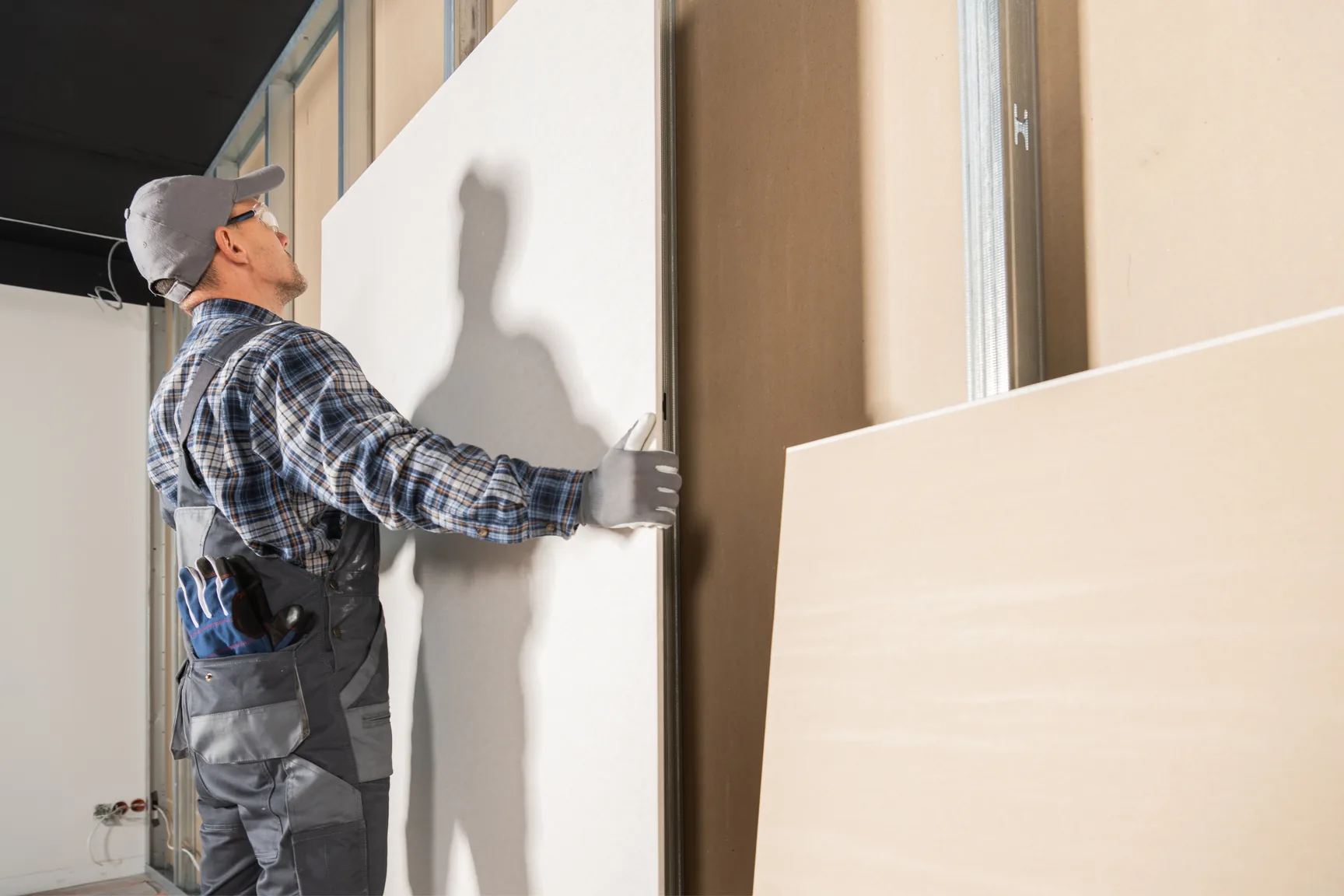
In Pennsylvania, the question that settles most of the state’s rules for a drywall crew is what kind of building the wall is in. Repair and remodeling work in a private residence calls for registration with the Pennsylvania Office of Attorney General under the state’s Home Improvement Consumer Protection Act, while new-home construction and commercial work sit outside that registration. Lead-safe renovation certification comes from EPA. Asbestos is governed by a state rule that adopts the federal emission standard whole, with the Pennsylvania Department of Labor and Industry certifying the people who do asbestos work. Workers’ compensation is compulsory for most employers, and a state fund is one of the places an employer can buy it.
The same sheet of board can fall under different rules depending on whose building it is fastened to. A crew that patches a ceiling in a twin home on Monday and hangs a tenant floor in an office building on Tuesday has crossed from one side of the registration to the other without changing a tool. How the policies themselves work is set out on the drywall contractor insurance page; work inside people’s homes is the subject of the residential drywall contractor insurance page, and board hung on general contractors’ projects is covered on the commercial drywall contractor insurance page.
A comparison in columns. The first column holds the work the state home improvement registration reaches: repairing, replacing, remodeling or installing walls and ceilings in a private residence, and the subcontractor who does that work for a remodeler, not only the business that signs with the homeowner. The Act never names drywall; it reaches this work through its general words. The second column holds what the registration leaves out: building a new home, and work for commercial or business use away from a private residence. The third column holds what stays with local government either way: building permits and enforcement of the building code, though a registered contractor owes no separate local registration. No figures are shown.
Home improvement registration: residential walls in, new homes and commercial space out
Pennsylvania’s Home Improvement Consumer Protection Act requires a contractor to register with the Office of Attorney General before performing home improvement work at a private residence. The Act never names drywall; it reaches residential hanging, taping and finishing through its general terms, which cover repair, replacement, remodeling, installation, alteration and renovation of a building used as a private residence, and subcontractors who do that work must register too.
The registration follows the kind of property, not the trade. The Act leaves out the construction of a new home and services furnished for commercial or business use away from a private residence, and the Attorney General’s guidance says it does not apply to commercial properties. Registration under the Act also bars cities, towns and counties from separately registering or licensing home improvement contractors, though they may still require building permits and enforce the building code.
Authority: 73 P.S. § 517.2; 73 P.S. § 517.3(a); 73 P.S. § 517.12
The core of the Act is a single prohibition:
“No person shall hold himself out as a contractor, nor shall a person perform any home improvement without first registering with the bureau, as provided for in this act.”
Nowhere does the Act say drywall, wallboard or plaster. It reaches a drywall crew through the general words it uses to define home improvement work on a private residence:
“Repair, replacement, remodeling, demolition, removal, renovation, installation, alteration, conversion, modernization, improvement, rehabilitation or sandblasting.”
Cutting out a water-stained section is repair and removal. Hanging new board in a finished basement is installation. Taking down a wall to open a kitchen is remodeling and alteration. None of those needs the word drywall to fall under the Act. Nor does the registration stop at the business holding the homeowner’s contract:
“Yes, subcontractors who perform home improvements must register even if they do not enter agreements directly with consumers.”
The other half of the finding is what the Act leaves out. Its definition of home improvement excludes new construction:
“The construction of a new home.”
It also excludes work for commercial or business use away from a home:
“The sale of services furnished for commercial or business use or for resale, if the service takes place somewhere other than at a private residence.”
Finally, the Act settles the relationship between the state registration and local government:
“Registration under this act shall preclude any requirement of payment of a fee or registration or licensing of any home improvement contractor by any political subdivision.”
“Political subdivisions shall be permitted to require building permits and local enforcement of the building code for that political subdivision, for which a reasonable fee may be charged.”
For an owner, the state registration and the local permit answer different questions. The registration is about your business and the kind of property it works on; the permit is about the particular job. Some habits follow:
- Sort your work by building type. If any of it is repair or remodeling inside private homes, settle the registration before that work starts, whether you hold the contract or work under someone who does.
- Keep a copy of the registration where the office can send it quickly; remodelers who hire you may ask for it.
- Ask the municipality about permits on each job rather than assuming the last town’s answer carries over.
- Check mixed cases against the Act before deciding it does not apply: a unit inside a larger building, or a home that is partly a business.
Older paint: a federal certification beside a state abatement program
Pennsylvania is not an authorized RRP state: EPA administers the lead renovation, repair and painting (RRP) program there, so the lead-safe certification a drywall firm needs for paid work that disturbs paint in older housing and child-occupied facilities comes from EPA.
Authority: 40 CFR Part 745; 34 Pa. Code § 203.1
Drywall work in an older building disturbs paint whether the crew means to or not. Opening a plaster wall, sanding a patch into an old finish or cutting out a section around a leak all reach the painted surface, and the federal rule is written around that kind of paid work:
“In general, anyone paid to perform work that disturbs paint in housing and child-occupied facilities built before 1978 must be certified in lead-safe work practices.”
Pennsylvania runs a lead program of its own, through the Pennsylvania Department of Labor and Industry, Bureau of Occupational and Industrial Safety, but it covers different ground.
The Pennsylvania Department of Labor and Industry runs the state’s own lead program, which certifies lead occupations and takes notice of lead-based paint abatement. The state rule’s definition of abatement leaves out renovation and remodeling by contractors whose aim is to repair, restore or remodel rather than to remove lead hazards, so cutting out or patching painted walls falls under the federal renovation rule rather than the state abatement program.
“Act 44 of 1995 and its regulations require that the Department of Labor & Industry (Department) be notified of work where lead-based paint is present and that persons certified by the Department perform this work whenever the following will occur”
The state rule draws its line around renovation in the definition of abatement:
“The term does not include renovation and remodeling or landscaping activities by contractors whose primary intent is not to permanently eliminate or reduce lead-based paint hazards, but is instead to repair, restore or remodel a given structure or dwelling.”
A drywall crew repairing or remodeling painted walls therefore needs the federal renovation certification. The state program is about abatement, work whose purpose is to get rid of the lead hazard, and about certifying the people in lead occupations. As advice, put these questions on the estimate sheet for any older building: when it was built, whether it is housing or a place young children use, how much painted surface the crew will disturb, and who on the job holds the certification. If anyone asks you to remove lead hazards rather than repair a wall, look at the state program before you price it. How a liability policy treats a claim involving lead is worked through on the general liability page.
An asbestos rule borrowed whole from the federal standard
Two Pennsylvania agencies share asbestos. The Department of Environmental Protection’s rule adopts the federal asbestos emission standard in its entirety, and the department regulates the removal and disposal of asbestos-containing material; the Department of Labor and Industry certifies asbestos contractors, supervisors and workers and must be notified before friable material is abated. Neither the state rule nor the retained guidance names joint compound, wallboard or plaster; they reach wall and ceiling material through the friable and nonfriable categories.
Authority: 25 Pa. Code §§ 124.2, 124.3; 40 CFR Part 61, Subpart M; Asbestos Occupations Accreditation and Certification Act
Rather than write an asbestos standard of its own, Pennsylvania’s environmental rule takes in the federal emission standard as written:
“National Emission Standards for Hazardous Air Pollutants promulgated in 40 CFR Part 61 … are hereby adopted in their entirety by the Department and incorporated herein by reference.”
The federal definitions are therefore the state rule’s definitions, and two of them do most of the work for a drywall business. The first reaches material that seems solid on the wall but that renovation is likely to break down:
“Category II nonfriable ACM that has a high probability of becoming or has become crumbled, pulverized, or reduced to powder by the forces expected to act on the material in the course of demolition or renovation operations regulated by this subpart.”
The second is the definition of a facility, which carries the residential exclusion in its own words:
“any institutional, commercial, public, industrial, or residential structure, installation, or building (including any structure, installation, or building containing condominiums or individual dwelling units operated as a residential cooperative, but excluding residential buildings having four or fewer dwelling units)”
Pennsylvania’s own rule text, the Department of Environmental Protection’s hazardous air pollutant chapter of the Pennsylvania Code, adopts the federal asbestos emission standard in its entirety by reference and does not itself name joint compound, wallboard, gypsum board, drywall, plaster or surfacing material. The reach comes through the adopted categories as the Department of Environmental Protection summarizes them: friable material that crumbles by hand pressure, and nonfriable material that renovation is likely to crumble or reduce to powder. The department’s fact sheet says sawing, scraping or sanding asbestos material makes fibers more likely to become airborne. The same fact sheet says a single small residential building is not a regulated facility under the federal standard, while the Department of Labor and Industry’s notification still reaches friable removal in an exempt private residence when someone other than the homeowner does it. Philadelphia and Allegheny Counties keep their own rules.
The departments’ pages explain how the program runs in practice. What follows is their guidance, not the text of the rule. The Pennsylvania Department of Environmental Protection, Bureau of Air Quality, asbestos program states why sanding and scraping matter:
“if materials containing asbestos are disturbed—for example sawed, scraped, or sanded into a powder—asbestos fibers are more likely to become airborne and inhaled into the lungs.”
On private homes, its guidance follows the rule’s exclusion:
“DEP does not regulate the removal of ACM from private residences unless the residence is an apartment with five or more units.”
That exclusion is narrower than it looks, because the environmental rule is only half of the state’s asbestos program. The other half belongs to the Pennsylvania Department of Labor and Industry, Bureau of Occupational and Industrial Safety, which certifies the people who do asbestos work and takes the notifications, as the Pennsylvania Department of Environmental Protection’s fact sheet describes:
“State regulations stipulate that it is illegal for anyone to engage in any asbestos occupation (worker, supervisor, project designer, inspector, management planner, or contractor) without proper certification from L&I.”
“L&I requires a five-day prior notification for friable asbestos … (including the EPA/DEP exempt private residence when the friable asbestos is removed by someone other than the homeowner).”
Local rules add to this in some places:
“Additional regulations exist for demolition and renovation of any building containing ACM in Philadelphia and Allegheny Counties.”
For a drywall owner, a small home is outside the federal facility definition but not outside the state’s certification and notification. The exemption says which rule applies; it says nothing about what is in a particular ceiling.
- On commercial work and larger residential buildings, ask for the asbestos inspection before you price demolition, and read what it found on the walls and ceilings you are opening.
- On small homes, do not take the exemption as a clean bill. If a textured ceiling or an old finish is coming down, ask whether it has been tested.
- If regulated material has to come out and your business is not certified, schedule a certified asbestos contractor ahead of your crew.
Whether a liability policy responds to a claim involving asbestos is taken up on the general liability page.
Insuring the payroll: an authorized insurer, self-insurance or the state fund
Workers’ compensation is mandatory for most employers in Pennsylvania. An employer buys it from a licensed insurance carrier or from a state fund that operates within the Department of Labor and Industry, or applies to the Bureau of Workers’ Compensation for approval to self-insure. An employer without coverage may face lawsuits by employees and criminal prosecution.
Authority: Workers’ Compensation Act § 305(a)(1); § 1502; § 1504; 77 P.S.
“Workers' compensation coverage is mandatory for most employers under Pennsylvania law. Employers who do not have workers' compensation coverage may be subject to lawsuits by employees and to criminal prosecution by the commonwealth.”
The statute’s security section sets out where the coverage can come from:
“Every employer liable under this act to pay compensation shall insure the payment of compensation in the State Workmen's Insurance Fund, or in any insurance company, or mutual association or company, authorized to insure such liability in this Commonwealth, unless such employer shall be exempted by the department from such insurance.”
The fund it names, now the State Workers’ Insurance Fund, is a fund of the Commonwealth, continued by the same Act:
“Certain sums to be paid by employers, as provided in this article, are hereby continued as a fund, hereafter to be known as the State Workers' Insurance Fund”
The route around insurance is self-insurance, approved by the Pennsylvania Department of Labor and Industry, Bureau of Workers’ Compensation:
“employers can apply to the bureau to seek approval to self-insure their liability.”
For a drywall business, that leaves a real choice. As advice, compare the State Workers’ Insurance Fund and insurers authorized in Pennsylvania on the same payroll and the same work, and remember that the rest of your program is still placed in the private market whichever route you take for the crew. Hangers and tapers paid by the board or the job, and finishing crews brought in under a separate business, raise policy questions rather than Pennsylvania questions; they are set out on the workers’ compensation page. Nothing verified on this page crosses a state line.
Which office answers which question
The Pennsylvania Insurance Department regulates insurance in the state. You can look up an insurance agency’s license, ours included, on NIPR.com. The other bodies this page draws on are listed with the role the record verified:
- Pennsylvania Office of Attorney General: home improvement contractor registration under the Home Improvement Consumer Protection Act (Bureau of Consumer Protection)
- Pennsylvania Department of Labor and Industry: state labor department: lead and asbestos occupation certification, workers’ compensation administration
- Pennsylvania Department of Labor and Industry, Bureau of Occupational and Industrial Safety: state lead program: lead occupation certification and abatement notification; RRP itself is EPA-administered
- Pennsylvania Department of Environmental Protection: state environmental agency
- Pennsylvania Department of Environmental Protection, Bureau of Air Quality, asbestos program: asbestos NESHAP: removal, collection, transportation and disposal of asbestos-containing material, and project notifications
- Pennsylvania Department of Labor and Industry, Bureau of Occupational and Industrial Safety: asbestos occupation and contractor certification and notification under the Asbestos Occupations Accreditation and Certification Act
- Pennsylvania Department of Labor and Industry, Bureau of Workers’ Compensation: workers’ compensation administration and self-insurance approval
Lead occupations, asbestos occupations and workers’ compensation all run from the Pennsylvania Department of Labor and Industry, while the registration that most affects residential drywall work sits with the Pennsylvania Office of Attorney General rather than a licensing board. For permits on a particular job, call the municipality where the building sits.
Metro areas and the counties inside them
The metro areas below are the largest metropolitan areas whose principal cities are in Pennsylvania, as the U.S. Census Bureau delineates them. The home improvement registration is statewide, so it travels with a crew across every county on these cards, while building permits stay with each municipality.
Philadelphia-Camden-Wilmington, PA-NJ-DE-MD
This metro reaches beyond Pennsylvania, and this card names only its Pennsylvania counties: Bucks County, Chester County, Delaware County, Montgomery County and Philadelphia County.
Pittsburgh, PA
Pennsylvania counties in this metro: Allegheny County, Armstrong County, Beaver County, Butler County, Fayette County, Lawrence County, Washington County and Westmoreland County.
Allentown-Bethlehem-Easton, PA-NJ
This metro reaches beyond Pennsylvania, and this card names only its Pennsylvania counties: Carbon County, Lehigh County and Northampton County.
Harrisburg-Carlisle, PA
Pennsylvania counties in this metro: Cumberland County, Dauphin County and Perry County.
Scranton--Wilkes-Barre, PA
Pennsylvania counties in this metro: Lackawanna County, Luzerne County and Wyoming County.
Lancaster, PA
Pennsylvania counties in this metro: Lancaster County.
As advice, when a metro spans a state line, the registration on this page is Pennsylvania’s alone; work on the other side is governed by that state’s rules.
Where the coverage pages take over
The policies that answer for the work itself are the set a drywall business carries wherever it works:
- General liability for injury and damage to others, including finished work and tear-out.
- Workers’ compensation for the crew, whichever route you buy it through.
- Commercial auto for the vans and trucks that carry board, mud and lifts.
- Inland marine coverage for tools and equipment for lifts, taping tools and sanders.
- Umbrella liability for limits above the primary liability policies.
- Commercial property for the shop and what is kept in it.
Which of those matter most follows the line the registration draws: a crew in people’s homes meets homeowners, older paint and small-building questions, while a crew hanging board for general contractors meets subcontracts and certificate requests. When you are ready to put the pieces together for Pennsylvania work, a quote request is the place to start.
State rules decide who may do the work and how; the policies decide who pays when something goes wrong.
- A license, registration or certification is a requirement of the state, not insurance.
A panel for Pennsylvania in rows. Each row sets a requirement of the state beside the exposure that requirement leaves open and the coverage line that answers it. Contractor license: A state license or registration reaches drywall work. It leaves open injury and damage to others from the work, during the job and after it, which General Liability answers. Lead-safe renovation: The federal program runs lead-safe renovation here. It leaves open paint dust disturbed when older walls are cut, patched or sanded, which General Liability answers. Asbestos in wall and ceiling material: A state program reaches removal of this material. It leaves open disturbing older joint compound, wallboard or plaster, which General Liability answers. Workers’ compensation: Required for covered employers, from the open market or the state fund. It leaves open a crew member hurt on the job, which Workers’ Compensation answers. Notes: A license, registration or certification is a requirement of the state, not insurance. The conclusion reads: State rules decide who may do the work and how; the policies decide who pays when something goes wrong. No figures are shown.
Nearby states we also write
Pennsylvania coverage, services and state offices
What we insure
Coverage lines
Outside authorities
- Pennsylvania Insurance Department
- Pennsylvania Office of Attorney General
- Pennsylvania Department of Labor and Industry
- Pennsylvania Department of Environmental Protection
- Pennsylvania Department of Environmental Protection, Bureau of Air Quality, asbestos program
- Pennsylvania Department of Labor and Industry, Bureau of Occupational and Industrial Safety
- Pennsylvania Department of Labor and Industry, Bureau of Workers’ Compensation
- Pennsylvania Department of Labor and Industry, Bureau of Occupational and Industrial Safety
Pennsylvania drywall contractor insurance questions
Our crews only hang and finish board in new houses for a builder. Does the home improvement registration apply to us?
The Home Improvement Consumer Protection Act lists the construction of a new home among the things its definition of home improvement does not include, and the Pennsylvania Office of Attorney General says the law does not apply to commercial properties. If your whole book is new-home work for a builder, the registration may not reach it. Most drywall businesses also take repair and remodeling calls, though, and the first job inside an existing home brings the Act back into play, so check your own mix of work against the Act before you decide.
We work as a subcontractor for a remodeler who signs every homeowner contract. Do we have to register on our own?
Yes. The Pennsylvania Office of Attorney General answers that question directly in its guidance: subcontractors who perform home improvements must register even when they never sign an agreement with the homeowner. Registering before you take the next residential job is simpler than explaining later why you did not.
A township asked us for its own contractor registration and fee. Is that allowed on top of the state registration?
The Act says registration under it rules out a separate fee, registration or license for home improvement contractors from any political subdivision, which takes in cities, towns and counties. Local governments may still require building permits and enforce their building code, and may charge a reasonable fee for that. As advice, ask the township which of those it is asking for, and pull the permit if a permit is what the job needs.
Does the state’s lead program certify our crew to cut out and patch painted walls in older homes?
No. The renovation certification for that work comes from EPA, which runs the lead renovation, repair and painting program in Pennsylvania. The Pennsylvania Department of Labor and Industry runs the state’s lead program, which certifies lead occupations and takes notice of lead-based paint abatement, and the state rule’s definition of abatement leaves out repair and remodeling work whose aim is not to remove lead hazards.
We scrape textured ceilings in small duplexes and single homes. Does any asbestos rule reach those jobs?
The federal standard Pennsylvania adopts leaves small residential buildings out of its definition of a covered facility, and the Pennsylvania Department of Environmental Protection says it does not regulate removal from private residences unless the residence is a larger apartment building. The Pennsylvania Department of Labor and Industry is a different matter: its notification still reaches friable asbestos removed from an exempt private residence by someone other than the homeowner, and anyone in an asbestos occupation needs its certification. If the texture tests positive, plan on a certified asbestos contractor before your crew scrapes.
Our insurer will not renew our workers’ compensation. Is there a state option for a drywall business in Pennsylvania?
There is. The Workers’ Compensation Act lets an employer insure in the State Workers’ Insurance Fund, which operates within the Pennsylvania Department of Labor and Industry, as well as with an insurer authorized to write the coverage in Pennsylvania. An employer can also apply to the Pennsylvania Department of Labor and Industry, Bureau of Workers’ Compensation for approval to self-insure. Coverage is mandatory for most employers, so do not let the policy lapse while you look.
We are redoing the walls in a single condominium unit inside a large building. Does the home improvement registration reach that job?
It can. Asked whether the law applies to commercial properties, the Pennsylvania Office of Attorney General answers by listing the residential property the law does reach: single family homes, small multifamily dwellings, and single units within a larger multifamily building, condominiums and cooperative units included. Repair or remodeling inside such a unit is the kind of work the registration covers, even when the building around it is large.
This page describes insurance for drywall contractors operating in this state. It is general information, not legal advice and not a statement of coverage. Licensing, lead-safe and asbestos requirements change; verify current requirements with the agency named before relying on them.
Get a quote for your Pennsylvania drywall work
Tell us how your work splits between homes and commercial sites, how old the buildings you open up tend to be and who is on the payroll, and we will shape the program around that.