
Drywall Contractor Insurance by State
New Jersey Drywall Contractor Insurance
Repair and remodeling work on New Jersey homes runs through a state business registration, older paint through the federal lead rule, asbestos work through a state license, and the payroll through a compulsory workers’ compensation law with no state fund.
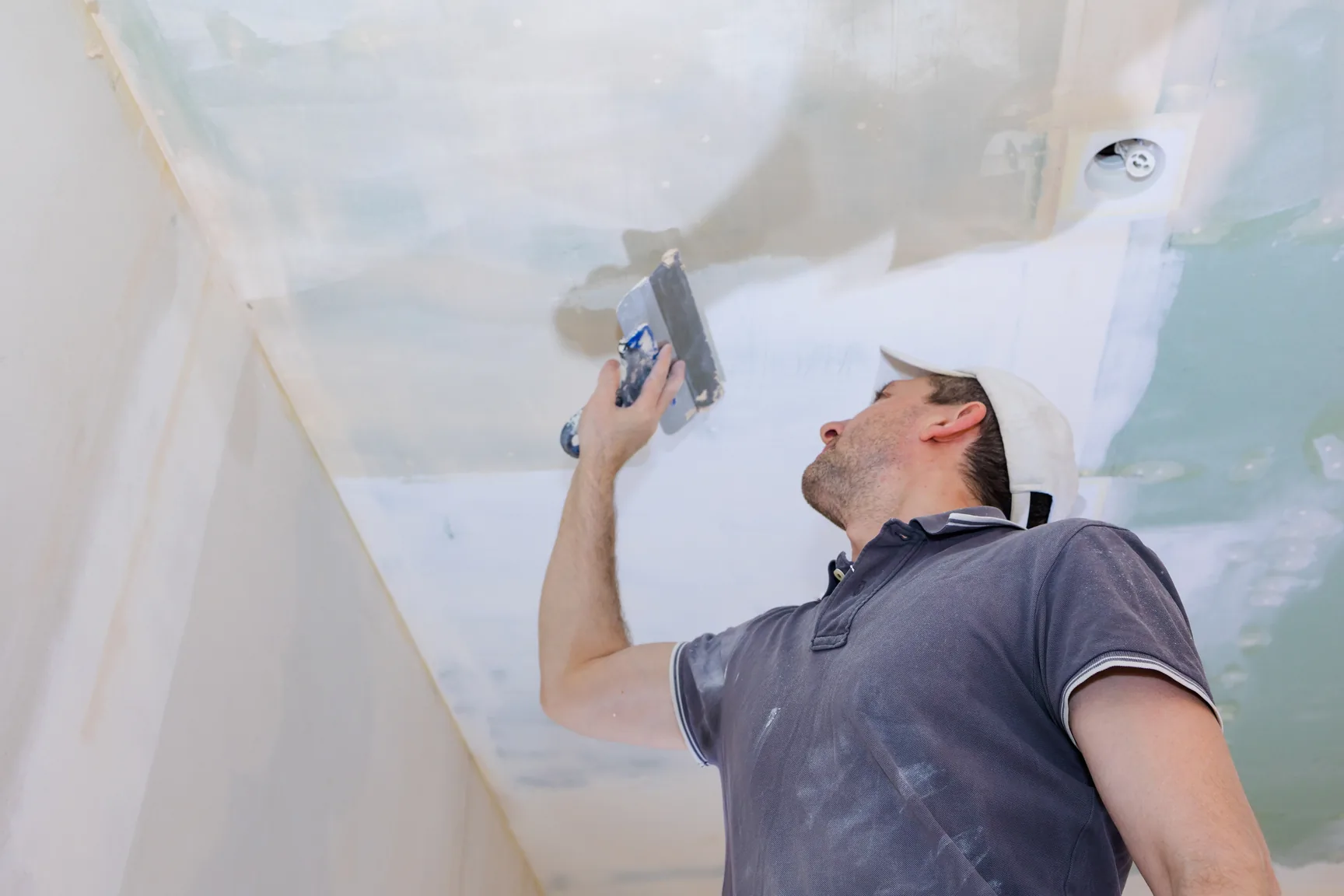
Residential drywall work in New Jersey runs through a business registration, not a trade license. A business that offers or does repair, remodeling or renovation work on homes registers with the Division of Consumer Affairs and renews the registration every year; building a new home is outside that law’s definition, and no statewide license reaches commercial drywall work. A separate licensing act names drywall installation as a specialty a state board may license, but by the act’s own words that license duty is not yet in force, and this page could not confirm that the board has adopted the rules that would start it. Lead-safe renovation certification comes from EPA, the New Jersey Department of Labor and Workforce Development licenses asbestos work in any building, public or private, and workers’ compensation is compulsory, placed in the private market or carried as approved self-insurance, with no state fund.
Some of those findings are easy to misread, and in opposite directions. The registration law never uses the word drywall, so a crew can assume it is not covered when it is. The licensing act does use the word, so a crew can assume a drywall license is required today when the act itself says the duty is still waiting.
How the policies behind a drywall business work in any state is the subject of the drywall contractor insurance page and the coverage pages linked from it. Here the focus stays on New Jersey, whether your crews patch ceilings and refinish walls for homeowners, the ground the residential drywall contractor insurance page covers, or hang and tape board for general contractors on commercial projects, which the commercial drywall contractor insurance page takes up.
A cascade read from top to bottom, each step holding only what the step above it lets through. At the top is every paid drywall job in the state: whatever the building, the employer’s workers’ compensation duty applies, and the license questions begin below it. The next step asks whether the property is residential. Commercial work drops out here, because the home improvement registration reaches residential property only and no statewide license reaches commercial drywall work. The step after that asks whether the home already stands. The construction of a new residential property is outside the law’s definition, so new-home work drops out and falls to the builder registration the law points to. What is left is repair, remodeling and renovation of existing homes, and for that work the business registers with the Division of Consumer Affairs and renews the registration every year. At the bottom sits a drywall specialty license that a separate licensing act names, shown as waiting: by the act’s own words its license duty does not operate until a period after the board adopts its rules, so ask the Division before relying on either answer. No figures are shown.
A yearly registration for work on homes that already stand
New Jersey reaches residential drywall work through a state registration. A contractor business may not offer, sell or perform home improvements unless it is registered every year with the Division of Consumer Affairs, and the law defines home improvement as remodeling, altering, renovating, repairing or otherwise improving the whole or any part of any residential property, which takes in hanging, taping and patching wallboard in an existing home without naming drywall. A newer licensing law creates a state board that may issue limited specialty licenses in drywall installation and in painting and plastering, but its duty to hold a license stays inoperative until a set period after the board adopts its rules.
Authority: N.J.S.A. 56:8-136 et seq.; 56:8-137; 56:8-138(a), (b), (h); 56:8-140; N.J.S.A. 45:5AAA-1 et seq.; 45:5AAA-5(b); 45:5AAA-6(j); 45:5AAA-9; N.J.S.A. 34:11-56.48 et seq.
The duty attaches to the business, not to a trade, and the registration law states it in a single sentence:
“No contractor business shall offer to perform, or engage, or attempt to engage in the business of making or selling home improvements unless registered with the Division of Consumer Affairs”
Drywall is never named in that law. The work comes in through the definition of home improvement, which is written broadly enough to take in hanging, taping and patching inside a house that is already built:
“"Home improvement" means the remodeling, altering, renovating, repairing, restoring, modernizing, moving, demolishing, or otherwise improving or modifying of the whole or any part of any residential property.”
The same definition stops where new construction begins:
“Home improvement shall not include the construction of a new residential property.”
The registration reaches residential property only, and the law’s own definition leaves out the construction of a new residential property, so drywall in a new home falls to the builder registration that law points to, and commercial drywall work falls outside it entirely. No statewide license reaches commercial drywall work; a contractor bidding public work that carries the prevailing wage must register with the Department of Labor and Workforce Development, and that duty follows the contract, not the trade.
Read against that definition, the ordinary residential jobs a drywall business takes are improvements to existing residential property: a water-stained ceiling cut out and replaced, a basement framed and finished, a cracked seam retaped in a hallway. As advice:
- Register before the first residential bid goes out, and put the renewal on the office calendar so it never lapses between jobs.
- Sort your work by building, not by task. Hanging board in a new house for a builder and patching the same board in an older house are different questions under this law, and the builder can tell you which registration covers its project.
- Treat commercial and public jobs as a separate track. Ask the building department, the general contractor and, on prevailing-wage public work, the labor department what each needs from you before the board is delivered.
A drywall license written into law that has not yet taken effect
A separate licensing act goes further than the registration law, and it names drywall where the registration law does not. It creates a state board within the Division of Consumer Affairs, and among the licenses the act lets that board issue are these:
“issue, from time to time and as determined by the board, limited specialty services licenses in home improvement contracting specialties, including, but not limited to, drywall installation; painting and plastering;”
The act’s license duty, in its most recent amended form, is written for individuals:
“no individual shall perform home improvement services or home elevation services unless licensed by the board or working under the direction or supervision of an individual licensed by the board.”
Read alone, that sentence would settle the question. It does not stand alone. The act holds its license-duty sections back until the board has acted:
“shall remain inoperative until the first day of the sixth month next following the promulgation by the board of the rules and regulations.”
Whether the board has adopted those rules could not be confirmed from a first-party page when this page was researched. This page therefore does not say a drywall license is required in New Jersey today, and it does not say one never will be. What it can say is what the act’s words say: drywall installation is named as a specialty, and the duty to hold a license waits on the board.
- Ask the Division of Consumer Affairs whether the board’s rules have been adopted, when the license duty starts and whether a drywall installation specialty license is being issued, and ask again before each busy season.
- Because the duty as written lets people work under the direction or supervision of a licensed individual, it is worth knowing now who would supervise each crew if the duty takes effect.
- Keep the registration current in the meantime. Nothing in the licensing act, as quoted here, replaces it.
The proof a homeowner may ask for before a repair job is discussed on the residential drywall contractor insurance page, and the certificates and additional insured wording a general contractor asks for are on the commercial drywall contractor insurance page.
Renovator certification from the federal agency, abatement certification from the state
New Jersey is not an authorized RRP state: EPA administers the lead renovation, repair and painting program there, so the lead-safe certification a drywall firm needs for paid work that disturbs paint in older homes, child care facilities and preschools comes from EPA. The state’s own contractor page sends renovators to EPA’s regional office.
Authority: 40 CFR Part 745; N.J.A.C. 5:17-2.1(a), (c)(3)
The federal agency’s own page explains how the program is divided, and the list of authorized programs that follows does not include New Jersey:
“EPA administers the RRP Program in most Tribes, states and territories, but has authorized the following to operate their own programs:”
The state’s own lead page credits the requirement to the federal agency in its guidance:
“EPA lead-safe work practices and certification requirements have been in effect since April 2010 for individuals who conduct renovations or repairs in housing and child-occupied facilities built before 1978.”
The state runs a lead program of its own, but for a different kind of work.
The state runs its own program for a different job: the Department of Community Affairs certifies companies that perform lead evaluation or lead abatement under the Lead Hazard Evaluation and Abatement Code, and that code says a firm doing painting, structural renovation or other contracting that may disturb paint needs no abatement certification so long as it does not hold itself out as an abatement or evaluation firm.
“Any business firm engaging in painting, woodworking, structural renovation or other indoor or outdoor contracting services that may result in the disturbance of paint, provided that the firm does not hold itself out as certified by the Department”
The condition at the end of that passage matters. A drywall firm that cuts out and patches painted walls works under the federal renovation certification; it is not an abatement firm and should not describe itself as one in its estimates or its advertising. As advice, put the building’s age, whether young children spend time there and how much painted surface the crew will disturb on the estimate sheet, and know who on the job holds the federal certification. How a liability policy treats a claim that involves lead dust is taken up on the general liability page.
Any ceiling, any wall: how the asbestos act reaches a finished room
New Jersey’s Asbestos Control and Licensing Act and its licensing rule, run by the Department of Labor and Workforce Development, require any employer that removes, encloses, encapsulates or repairs asbestos in any structure to hold a state license, and each worker to hold a state permit. The rule never names joint compound, drywall, wallboard or plaster: it reaches them through its definition of asbestos-containing material, which covers material containing asbestos applied on any ceiling or wall.
Authority: N.J.S.A. 34:5A-34, 34:5A-36, 34:5A-37, 34:5A-43(b); N.J.A.C. 12:120-1.4, 12:120-2.1; N.J.A.C. 5:23-8.1, 5:23-8.2; 40 CFR 61, Subpart M
Start with the act. Its license duty is written around what the work does to asbestos, not around a trade or a material:
“No employer shall either directly or indirectly perform any of the functions of application, enclosure, removal, or encapsulation of asbestos in any structure”
What counts turns on the licensing rule’s definition of the material, and its list of surfaces opens with the ones a drywall crew spends its days on:
“"Asbestos-containing material" (ACM) means any material containing more than one percent asbestos which has been applied on any ceiling, wall, duct, boiler, tank, pipe, structural member, or on any other part of a building or equipment.”
The rule’s scope is just as wide:
“Any public or private building, structure or equipment on which asbestos work is performed, except as provided in (b) below.”
And damage changes what a material is. A finish that would not crumble on the wall can become friable once the work has broken it:
“"Friable" means asbestos-containing material that when dry may be crumbled, pulverized or reduced to powder by hand pressure, and includes previously non-friable asbestos-containing material after that material becomes damaged”
The rule’s exclusions are narrow — limited repair of small amounts, roofing and exterior siding outside demolition, and an employer’s own employees in its own facility — and its words carry no residential or homeowner exemption. The Department of Health’s own guidance says no regulation forbids a homeowner from removing asbestos in their own home, which is guidance about owners, not about a hired crew.
The departments’ own pages are guidance rather than the text of the rule. The New Jersey Department of Health puts the point about who may do the work plainly:
“All asbestos abatement work must be conducted by a DOLWD- licensed asbestos abatement contractor.”
The same department’s guidance carries the sentence most often repeated on residential jobs:
“Technically, there are no regulations that forbid a homeowner from removing asbestos in their own home themselves, but we strongly advise against it”
That is about owners working on their own homes, and even there the department advises against it. It is not a statement about a crew hired to do the work. As advice:
- On any job that opens an older ceiling or wall, ask whether the finish has been tested before you price the tear-out, and read what the results say about the surfaces you are touching.
- Write the method into the scope, and if the plan changes mid-job, stop and talk to the owner first.
- If tested material has to come out and your business does not hold the state license, plan for a licensed asbestos contractor to remove it, and schedule your crew after the removal.
Whether a liability policy responds to a claim involving asbestos is a question for the general liability page; a commercial renovation adds the subcontract’s insurance requirements, which the commercial drywall contractor insurance page covers.
Going without comp is an offense: insuring the payroll in New Jersey
Workers’ compensation is compulsory in New Jersey for private employers. Every employer under either article of the Workers’ Compensation law must make provision for its liability, by insuring with a stock company or mutual association authorized to write the coverage in New Jersey or by carrying the risk itself with the written approval of the Commissioner of Banking and Insurance, and failing to provide that protection is an offense. Coverage comes only from the private market.
Authority: N.J.S.A. 34:15-71; 34:15-72; 34:15-77; 34:15-78; 34:15-79(a); 34:15-9
The statute names the usual way to meet the duty, insurance from an insurer authorized to write the coverage in the state:
“Every employer not operating under section 34:15-77 of this title shall insure and keep insured his liability in any stock company or mutual association authorized to engage in workmen's compensation or employer's liability insurance in this State.”
The other route is carrying the risk directly, with the regulator satisfied that the business can pay:
“Any employer desiring to carry his own liability insurance may make application to the Commissioner of Insurance showing his financial ability to pay compensation.”
And the statute attaches a consequence to doing neither. The sentence that begins below goes on to make the failure an offense:
“An employer who fails to provide the protection prescribed in this article”
Neither route runs through a state insurer. For a drywall business, workers’ compensation is placed with an insurer authorized to write it in New Jersey, unless the business qualifies to carry the risk itself with the New Jersey Department of Banking and Insurance’s approval, and there is no state policy to fall back on if the coverage lapses.
Hangers paid by the board, tapers paid by the job and finishing outfits brought in under their own names raise questions about who counts as an employee. Those are policy questions more than state questions, worked through on the workers’ compensation page. As advice, settle how each person on a job is paid and documented before the policy audit asks. Nothing verified on this page crosses a state line.
Who to call about registration, asbestos, lead and comp
The New Jersey Department of Banking and Insurance regulates insurance in the state. You can look up an insurance agency’s license, ours included, on NIPR.com.
The other state bodies this page draws on each answer a different question. Each link goes to the source the finding was verified at, and each role is described as it was verified:
- Division of Consumer Affairs: contractor business registration for home improvement work; the State Board of Home Improvement and Home Elevation Contractors sits within it
- New Jersey Department of Labor and Workforce Development, Asbestos Control and Licensing: asbestos abatement contractor licensing and worker and supervisor permits
- New Jersey Department of Health: asbestos training certification and examinations; public guidance on asbestos and childhood lead
- New Jersey Department of Community Affairs: Lead Hazard Abatement: certification of lead evaluation and abatement contractors under the state’s Lead Hazard Evaluation and Abatement Code; RRP itself is EPA-administered; Asbestos Hazard Abatement Subcode for schools and public buildings
- Division of Workers’ Compensation: workers’ compensation administration and enforcement of the duty to insure
The board that would issue a drywall specialty license sits within the Division of Consumer Affairs, so that is also the office to ask about when the license duty begins. There is no state workers’ compensation fund to list, and for commercial work the offices that matter most are the building departments where your jobs sit.
Census metro areas that take in New Jersey counties
The cards below follow the metropolitan areas the U.S. Census Bureau delineates with New Jersey counties in them, ranked by size: metros whose principal cities are in New Jersey come first, followed by a metro whose principal cities sit across the state line.
New York-Newark-Jersey City, NY-NJ
This metro reaches beyond New Jersey, and this card names only its New Jersey counties: Bergen County, Essex County, Hudson County, Hunterdon County, Middlesex County, Monmouth County, Morris County, Ocean County, Passaic County, Somerset County, Sussex County and Union County.
Philadelphia-Camden-Wilmington, PA-NJ-DE-MD
This metro reaches beyond New Jersey, and this card names only its New Jersey counties: Burlington County, Camden County, Gloucester County and Salem County.
Trenton-Princeton, NJ
New Jersey county in this metro: Mercer County.
Atlantic City-Hammonton, NJ
New Jersey counties in this metro: Atlantic County and Cape May County.
Vineland, NJ
New Jersey county in this metro: Cumberland County.
Allentown-Bethlehem-Easton, PA-NJ
This metro’s principal cities are outside New Jersey, and this card names only its New Jersey county: Warren County.
The registration is statewide, so it reads the same in every county on these cards. What changes from job to job is the kind of building: residential repair and remodeling falls under the registration wherever it sits, while commercial work has no statewide license. As advice, record for each job whether it is an existing home, a new home or a commercial building before the bid goes out.
Which coverage page to read next, finding by finding
The findings above describe where New Jersey’s rules sit. The coverage that answers for the work is the set of policies a drywall business carries wherever it works:
- General liability for injury and damage to others, including tear-out and work already finished.
- Workers’ compensation for the crew, including hangers and tapers paid by the piece.
- Commercial auto for the vans that haul board, compound and lifts.
- Inland marine coverage for tools and equipment for the lifts, banjos, flat boxes and sanders that move from site to site.
- Umbrella liability for limits above the primary liability policies, often written into a subcontract.
- Commercial property for the shop and its stock.
When you are ready to put the pieces together for New Jersey work, a quote request is the place to start.
State rules decide who may do the work and how; the policies decide who pays when something goes wrong.
- A license, registration or certification is a requirement of the state, not insurance.
A panel for New Jersey in rows. Each row sets a requirement of the state beside the exposure that requirement leaves open and the coverage line that answers it. Contractor license: A state license or registration reaches drywall work. It leaves open injury and damage to others from the work, during the job and after it, which General Liability answers. Lead-safe renovation: The federal program runs lead-safe renovation here. It leaves open paint dust disturbed when older walls are cut, patched or sanded, which General Liability answers. Asbestos in wall and ceiling material: A state program reaches removal of this material. It leaves open disturbing older joint compound, wallboard or plaster, which General Liability answers. Workers’ compensation: Required for covered employers, bought in the open market. It leaves open a crew member hurt on the job, which Workers’ Compensation answers. Notes: A license, registration or certification is a requirement of the state, not insurance. The conclusion reads: State rules decide who may do the work and how; the policies decide who pays when something goes wrong. No figures are shown.
Nearby states we also write
New Jersey coverage, services and state offices
What we insure
Coverage lines
Outside authorities
- New Jersey Department of Banking and Insurance
- Division of Consumer Affairs
- New Jersey Department of Labor and Workforce Development, Asbestos Control and Licensing
- Division of Workers’ Compensation
- New Jersey Department of Community Affairs
- New Jersey Department of Community Affairs
- New Jersey Department of Health
New Jersey drywall contractor insurance questions
Before we sign a homeowner’s contract to finish a basement, what has to be in place with the state?
A home improvement registration for the business. The registration law says no contractor business may offer, sell or do home improvement work unless it is registered with the Division of Consumer Affairs, and every contractor business registers again each year. Finishing a basement in a house that already stands is improving part of a residential property, which is how the law defines home improvement, so register before the contract is signed rather than after.
I keep hearing that the state now licenses drywall installers. Do my finishers need that license right now?
Not on what this page could verify. A separate licensing act names drywall installation and painting and plastering among the specialty licenses a state board may issue, but the act also says its license duty stays inoperative until a set period after the board adopts its rules, and whether that has happened could not be confirmed from a first-party page. Ask the Division of Consumer Affairs, where the board sits, before you rely on either answer.
A school district wants bids on a public renovation that pays the prevailing wage. Is there a registration for that work?
Yes, and it follows the contract rather than the trade. The New Jersey Department of Labor and Workforce Development says anyone bidding on or working under a public works contract subject to the Prevailing Wage Act must register with its wage and hour division. That is separate from the home improvement registration, which reaches residential property only, so a drywall business doing both kinds of work may need both.
We cut into painted walls in older houses before we patch them. Do we need the state’s lead abatement certification?
Usually not for that. The New Jersey Department of Community Affairs certifies companies that perform lead evaluation or lead abatement, and its rule says a firm doing painting, renovation or other contracting that may disturb paint needs no abatement certification so long as it does not hold itself out as an abatement or evaluation firm. The renovation certification for paid work on older painted walls comes from EPA, which runs that program in New Jersey.
The asbestos rule never mentions joint compound. How could an old taped seam still fall under it?
Through its definitions. The rule defines asbestos-containing material as material containing asbestos above its threshold applied on any ceiling, wall or other part of a building, and the act requires a license to remove, enclose or encapsulate asbestos in any structure. The test is what is in the material, not what it is called, so ask for testing before your crew sands or tears out an older finish.
The health department says no rule stops homeowners from removing asbestos in their own homes. Can our crew lean on that?
No. That statement is New Jersey Department of Health guidance about owners working on their own homes, and the department strongly advises against it even then. The licensing rule’s own words carry no residential or homeowner exemption, and the department’s guidance says all asbestos abatement work must be done by a contractor licensed by the New Jersey Department of Labor and Workforce Development. A hired crew without that license should leave the removal to a licensed asbestos contractor.
What happens to an employer here that lets its workers’ compensation lapse?
The law treats it as an offense. New Jersey requires every employer it covers to insure with an authorized insurer or carry the risk itself with approval from the New Jersey Department of Banking and Insurance, and an employer that fails to provide that protection is guilty of an offense under the statute. There is no state fund to fall back on, so keep the policy in force and renew it before it ends.
This page describes insurance for drywall contractors operating in this state. It is general information, not legal advice and not a statement of coverage. Licensing, lead-safe and asbestos requirements change; verify current requirements with the agency named before relying on them.
Get a quote for your New Jersey drywall work
Tell us how your work divides between existing homes, new construction and commercial space, what kinds of ceilings and walls your crews open up and who is on the payroll, and we will build the program from there.