
Drywall Contractor Insurance by State
Idaho Drywall Contractor Insurance
Idaho asks a drywall firm to register with its contractors board and show liability and comp proof, leaves lead-safe certification to EPA, sends asbestos questions on public and commercial buildings to EPA’s regional office and requires workers’ compensation.
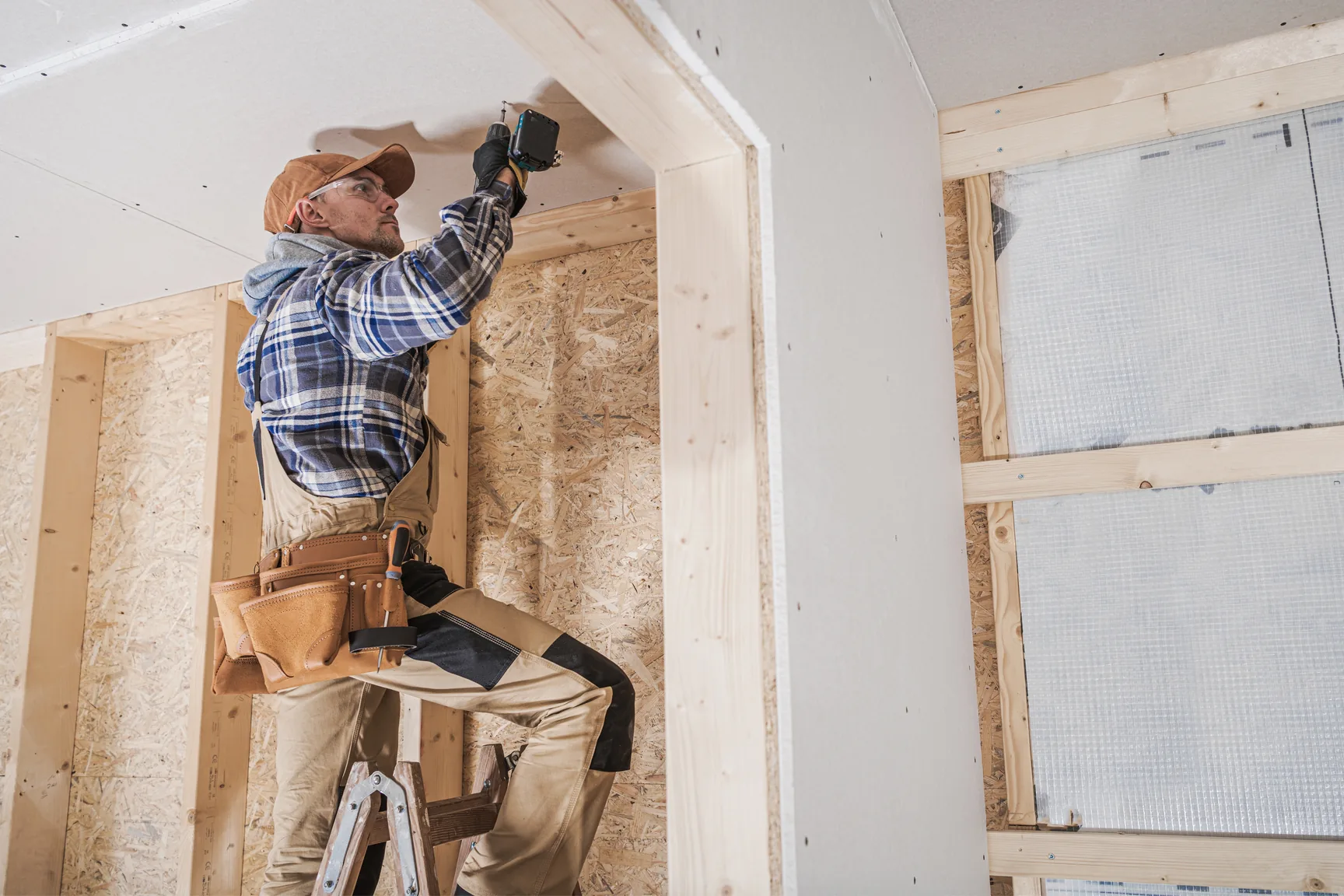
Before a drywall firm bids work in Idaho, it registers with the Idaho Contractors Board, and the application that gets it registered already asks about insurance: a general liability certificate that includes products and completed operations, and proof of workers’ compensation or a reason none is needed. The state runs no lead-safe renovation certification of its own, so that comes from EPA. On asbestos, Idaho’s air rules adopt the federal standard, but the state’s environmental agency says the federal regional office has jurisdiction over public, commercial and institutional buildings and the other nonmajor facilities where drywall work happens. Workers’ compensation is compulsory for every employment the law does not exempt.
So the state paperwork is where the insurance question first comes up, while the environmental side of the job is largely federal. How the policies respond to drywall work anywhere is covered on the drywall contractor insurance page, with repair work in occupied homes on the residential drywall contractor insurance page and hanging and taping on general contractors’ projects on the commercial drywall contractor insurance page. This page keeps to Idaho.
A comparison in columns, read left to right. The left column is what the Idaho Contractors Board asks for. A firm registers before it contracts, because the Act reaches any part of building, altering or repairing a structure, though it never names drywall. The application carries a general liability certificate that includes products and completed operations, and proof of workers’ compensation insurance or the contractor’s statement of why none is required. A contractor may not engage another contractor who must register without proof that it has. The middle column is what the federal agency oversees in Idaho. Lead-safe renovation certification comes from the federal agency, because Idaho is not on its list of states that run their own renovation programs. For asbestos, the state environmental agency says its delegated authority reaches only top-tier major facilities, and that the regional federal office has jurisdiction over public, commercial and institutional buildings. The right column is what the employer arranges: workers’ compensation, compulsory for employment the law does not exempt, in place before the first employee is hired, through an authorized insurer or self-insurance the Industrial Commission approves. No figures are shown.
Registered, not licensed: what the registration Act asks of a drywall firm
Idaho requires anyone in the business of contracting to register with the Idaho Contractors Board, part of the Division of Occupational and Professional Licenses, before working as a contractor in the state. The Idaho Contractor Registration Act reaches drywall work through its definition of construction — building, altering, repairing or improving any building or structure, or any part of that work — rather than by naming the trade. It is a registration, not a license, and the application asks for proof of general liability insurance that includes products and completed operations, and proof of workers’ compensation insurance or a statement of why it is not required.
Authority: Idaho Code § 54-5204(1), (2); Idaho Code § 54-5203(2), (3); Idaho Code § 54-5205(2)(f); Idaho Code § 54-5210(1)(d), (e)
The obligation attaches to the business of contracting, not to a named trade:
“On and after January 1, 2006, it shall be unlawful for any person to engage in the business of, or hold himself out as, a contractor within this state without being registered as required in this chapter.”
Whether a drywall firm is a contractor turns on what the Act means by construction, and the last words of the definition are the ones that matter for a trade that does a single stage of a building:
“means the performance of building, altering, repairing, adding to, subtracting from, improving, reconstructing, moving, excavating, wrecking or demolishing any building, highway, road, bridge, or other structure, project, development or improvement to real property, or to do any part thereof”
Hanging board, taping joints and patching a damaged wall are parts of building, altering or repairing a building, so the law reaches them without printing the word drywall. The board is careful about what to call the credential:
“The Act requires registration, not licensure.”
Keep that straight in your own paperwork. A general contractor from out of state may ask for a license number and a classification; in Idaho the answer is a registration number from the Idaho Contractors Board.
The statute lists its own exemptions, among them a small one-off job below its price threshold, a wage employee of a contractor and an owner working on the owner’s own property, and it makes it unlawful for a contractor to engage another contractor who must be registered without proof that the other one is.
That last point runs toward the firms you hire. Hand the taping on a large job to another crew, and the statute puts the check on you:
“It shall be unlawful for a contractor to engage any other contractor who is required by this chapter to be registered as a contractor unless such other contractor furnishes satisfactory proof to the contractor that he is duly registered …”
As advice, ask any firm you bring onto a job for its registration number before it starts, keep a copy in the job file, and expect the general contractors you work for to ask for yours.
Liability and comp proof inside the application file
Idaho’s registration law writes insurance into the application itself. The liability requirement is quoted here as the statute prints it, limit included:
“has in effect a general liability policy, including products and completed operations insurance covering the applicant’s construction operations in the sum of not less than three hundred thousand dollars ($300,000) single limit”
Note the phrase products and completed operations. A wall is finished, the crew leaves, and months later a seam cracks or a ceiling sags. The part of a liability policy that answers for work after it is turned over is explained on the general liability page, and the statute wants it in place before the firm registers. The limit in the statute is what the board accepts, not a recommendation, and it says nothing about what a subcontract will demand; the commercial drywall contractor insurance page walks through those requests.
The workers’ compensation proof sits in the same list:
“satisfactory proof that the applicant has procured and has in effect worker’s compensation insurance or a statement by the contractor as to why such certificate or coverage is not required”
The statement option exists because the comp law exempts some owners, as the comp section below shows. For a firm with a crew, comp is bound before registration, not later. As advice, keep both certificates current and send renewals to the general contractors you work for without waiting to be asked.
The renovator’s card for painted walls comes from EPA
Idaho is not an authorized RRP state: EPA’s list of states that run their own lead renovation, repair and painting programs leaves Idaho out, so the lead-safe certification a drywall firm needs for paid work that disturbs paint in older homes, child care facilities and preschools comes from EPA. EPA also runs the lead-based paint activities program for inspection, risk assessment and abatement in Idaho.
Authority: 40 CFR Part 745
Cutting out a water-stained section, opening a wall for a doorway or sanding a repair flush with the old finish all reach whatever coating is on that wall. The federal rule is written around that kind of paid work:
“In general, anyone paid to perform work that disturbs paint in housing and child-occupied facilities built before 1978 must be certified in lead-safe work practices.”
States may run the program themselves with the federal agency’s authorization. Its page lists the ones that do, and Idaho is not among them:
“EPA administers the RRP Program in most Tribes, states and territories, but has authorized the following to operate their own programs: Alabama, Delaware, Georgia, Iowa, Kansas, Massachusetts, Mississippi, North Carolina, Oklahoma, Oregon, Rhode Island, Utah, Vermont, Wisconsin …”
The Idaho Department of Health and Welfare runs the state’s own lead program as a public health program, the Idaho Childhood Lead Poisoning Prevention Program; its lead page names working in construction and renovating old homes among the ways adults are exposed to lead and describes no state certification for renovation contractors.
The Idaho Department of Health and Welfare page is written for the public, and it lists drywall-type work among the sources of exposure:
“Conducting home renovation, repair, remodeling, or painting (in structures built before 1978.)”
So the certification a drywall firm needs before disturbing paint in older housing or a child-occupied facility is the federal one, and the state’s program is health guidance, not a second credential. As advice, ask when the building went up on every repair call and write it on the estimate, and know which of your people holds the federal renovator certification. Repairs in occupied older homes raise these questions most, which is why the residential drywall contractor insurance page spends time on them.
Major facilities to the state, every other building to EPA’s regional office
Idaho’s air quality rules adopt the federal asbestos standard for renovation and demolition by reference, but the Idaho Department of Environmental Quality says EPA delegated it authority only at the major facilities in its top permit tier. For public, commercial and institutional buildings and every other nonmajor facility — where drywall work happens — EPA’s regional office has jurisdiction and receives the renovation and demolition notices, so the federal rule, enforced by EPA, governs this work. Neither the state rule nor the federal rule names drywall or joint compound; the federal rule reaches them through its categories, friable material and nonfriable material that renovation is likely to crumble or pulverize.
Authority: IDAPA 58.01.01.107.07; IDAPA 58.01.01.009; 40 CFR 61.141; 40 CFR 61, Subpart M
Start with the rule. Idaho’s air quality rules write no asbestos standard of their own; they take in the federal one by reference:
“National Emission Standards for Hazardous Air Pollutants. 40 CFR Part 61, revised as of July 1, 2025.”
Who enforces it is a separate question, and the Idaho Department of Environmental Quality answers it on its compliance page. This is the agency’s guidance, not the rule, quoted exactly:
“EPA delegated regulatory authority to DEQ to oversee the abatement and disposal of asbestos-containing materials at Tier 1 major facilities.”
“EPA Region 10 has jurisdiction over all nonmajor facilities (e.g., public, commercial, and institutional structures)”
That second sentence is the finding for this trade. Public, commercial and institutional buildings are nonmajor facilities in the agency’s terms, and the federal regional office has jurisdiction over them. No asbestos program of Idaho’s own reaches a drywall job there; the federal rule does, as the federal agency enforces it.
The federal text never names joint compound, wallboard or plaster. It reaches them by how a material behaves, starting with material that crumbles by hand when dry:
“Friable asbestos material means any material containing more than 1 percent asbestos … that, when dry, can be crumbled, pulverized, or reduced to powder by hand pressure.”
The next category matters more to a finisher, because it turns on what the work does to a material that starts out sound:
“Category II nonfriable ACM that has a high probability of becoming or has become crumbled, pulverized, or reduced to powder by the forces expected to act on the material in the course of demolition or renovation operations …”
The agency’s guidance is where a finished surface appears by name, as an example in its list of renovation quantities that call for the federal notice. Again, this is guidance, not the text of the rule:
“At least 160 square feet (15 square meters) of RACM measured by area (e.g., wall or ceiling texture)”
Houses sit apart. The federal definition of a covered facility carries its own exclusion:
“Facility means any institutional, commercial, public, industrial, or residential structure, installation, or building … but excluding residential buildings having four or fewer dwelling units)”
That exclusion takes those buildings out of the federal rule. It says nothing about whether a particular ceiling contains asbestos. As advice, on a commercial or public building ask the owner or general contractor for the asbestos inspection before you price any tear-out, write into the proposal which surfaces are cut, scraped or sanded, and leave regulated material to an abatement contractor trained for it. How a liability policy treats an asbestos claim is covered on the general liability page.
Crew coverage in place before the first paycheck
Workers’ compensation is compulsory in Idaho for the employments its law covers: the law applies to all public and all private employment not expressly exempted, and every employer must secure compensation either by insuring with an insurer the director of the Department of Insurance authorizes to write it, or by self-insuring with the Idaho Industrial Commission’s approval. An insurer created by statute also writes coverage for private employers; its statute makes it a body corporate that insures employers and is regulated as a mutual insurer, so it is described here by function, not named. Sole proprietors and working partners or LLC members are among the law’s exemptions.
Authority: Idaho Code § 72-203; Idaho Code § 72-301(1)(a), (b); Idaho Code § 72-212(6); Idaho Code § 72-901(1), (4); Idaho Code § 72-319(1)
The law’s default is that employment is covered:
“This law shall apply to all public employment and to all private employment including farm labor contracting not expressly exempt by the provisions of section 72-212, Idaho Code.”
An employer secures that coverage with an authorized insurer or by approved self-insurance:
“By insuring and keeping insured with a policy of worker’s compensation insurance … with any insurer, as defined in section 41-103, Idaho Code, authorized by the director of the department of insurance to transact such insurance”
“An employer may become self-insured by obtaining the approval of the industrial commission”
Timing is where owners slip. The Idaho Industrial Commission is direct about it:
“Workers’ Compensation is required to be in place before the first employee is hired.”
The contractor registration law ties the two together: an application to register with the Idaho Contractors Board must include proof of workers’ compensation insurance or the contractor’s statement of why it is not required, and the Industrial Commission says coverage must be in place before the first employee is hired.
The exemptions are what make the registration’s statement option possible. Among them:
“Employment as the owner of a sole proprietorship; employment of a working member of a partnership or a limited liability company;”
An owner working alone may fall inside that line; a firm with a hanger on the payroll does not. The insurer the legislature created is part of the market, and its statute shows how it stands apart from the state:
“There is hereby created as an independent body corporate politic a fund, to be known as … for the purpose of insuring employers against liability for compensation”
“Such fund shall be administered without liability on the part of the state.”
For an owner, comp is placed like the rest of the program, in the open market, with an insurer authorized to write it in Idaho or through self-insurance the commission approves. Hangers paid by the board or the foot and finishers brought in under a separate business are policy questions, taken up on the workers’ compensation page. As advice, settle how each person on a job is paid and documented before the premium audit asks.
Bookmarks for the office: the bodies named in these findings
The Idaho Department of Insurance regulates insurance in the state; in the record’s words, its role is insurance regulator; its director authorizes the insurers that may write workers’ compensation. You can look up an insurance agency’s license, ours included, on NIPR.com.
The rest of the bodies this page draws on each hold a separate piece. Each link goes to the agency’s own site, and each role is given as the record verified it:
- Idaho Contractors Board: contractor registration under the Idaho Contractor Registration Act
- Division of Occupational and Professional Licenses: statewide occupational licensing; houses the Idaho Contractors Board
- Idaho Department of Health and Welfare: state lead program (Idaho Childhood Lead Poisoning Prevention Program), a public health program; RRP itself is EPA-administered
- Idaho Department of Environmental Quality: state air quality rules; oversees asbestos work only at top-tier major facilities, with EPA’s regional office responsible for nonmajor facilities
- Idaho Industrial Commission: workers’ compensation administration, insurer and self-insurance approval
Missing from that list is a state office that certifies lead renovators, for the reason the lead section gives. The environmental agency is on it, but its own guidance sends asbestos questions about nonmajor facilities to the federal regional office, so for a commercial or public drywall job that office is the one to call.
Which counties belong to which metro
The cards below are the metropolitan areas whose principal cities are in Idaho, as the U.S. Census Bureau delineates them, with the counties each takes in. The contractor registration is statewide, so a registered firm carries the same credential into every county on these cards.
Boise City, ID
Idaho counties inside this metro: Ada County, Boise County, Canyon County, Gem County and Owyhee County.
Coeur d’Alene, ID
Idaho counties inside this metro: Kootenai County.
Idaho Falls, ID
Idaho counties inside this metro: Bonneville County, Butte County and Jefferson County.
Twin Falls, ID
Idaho counties inside this metro: Jerome County and Twin Falls County.
Pocatello, ID
Idaho counties inside this metro: Bannock County.
Lewiston, ID-WA
Part of this metro lies across the state line; only its Idaho counties are listed here: Nez Perce County.
As advice, treat the registration as the state’s answer and not the whole of what a job needs. Call the building office for each address and ask what it expects before the crew is scheduled, and keep the registration number on every bid and invoice.
What the contractors board leaves out of the insurance picture
The registration file covers liability and comp, and only at the level the board accepts. The rest of a drywall program sits outside it, and each part has its own page:
- General liability for injury and damage to others, including the completed operations the board asks about.
- Workers’ compensation for the crew, including piece-rate pay and subcontracted finishers.
- Commercial auto for the trucks and trailers that haul board, mud and lifts between the supplier and the site.
- Inland marine coverage for tools and equipment for lifts, stilts, banjos and sanders that move from job to job.
- Umbrella liability for limits above the primary policies, which a general contractor’s subcontract may require well beyond the registration minimum.
- Commercial property for the shop, the stored material and the office.
Which of those matter most depends on the work. A crew doing patch and repair in occupied homes faces different owners and older walls than a crew hanging board on a general contractor’s project, and the service pages take each on its own terms. When you are ready to put the pieces together for work in Idaho, a quote request is the place to start.
State rules decide who may do the work and how; the policies decide who pays when something goes wrong.
- A license, registration or certification is a requirement of the state, not insurance.
A panel for Idaho in rows. Each row sets a requirement of the state beside the exposure that requirement leaves open and the coverage line that answers it. Contractor license: A state license or registration reaches drywall work. It leaves open injury and damage to others from the work, during the job and after it, which General Liability answers. Lead-safe renovation: The federal program runs lead-safe renovation here. It leaves open paint dust disturbed when older walls are cut, patched or sanded, which General Liability answers. Asbestos in wall and ceiling material: The federal rule applies here, and EPA administers it for this work. It leaves open disturbing older joint compound, wallboard or plaster, which General Liability answers. Workers’ compensation: Required for covered employers, bought in the open market. It leaves open a crew member hurt on the job, which Workers’ Compensation answers. Notes: A license, registration or certification is a requirement of the state, not insurance. The conclusion reads: State rules decide who may do the work and how; the policies decide who pays when something goes wrong. No figures are shown.
Idaho coverage, services and state offices
What we insure
Coverage lines
Idaho drywall contractor insurance questions
A general contractor asked for our Idaho license number. What do we actually hold?
A contractor registration, issued through the Idaho Contractors Board, which sits within the Division of Occupational and Professional Licenses. The board’s own guidance says the Act requires registration, not licensure. As advice, give the general contractor your registration number and tell them it is a registration, so nobody on their side goes looking for a license class that does not exist.
We only hang and tape board. The registration law never says drywall, so does it reach us?
Yes. The Act defines construction as building, altering, repairing or improving a building or other structure, or doing any part of that work, and drywall installation and finishing is part of building or altering a building. The statute lists its own exemptions, and none of them is written for drywall.
A neighbor wants a small patch fixed. Does a job that size need the registration?
The statute exempts a single casual, minor or inconsequential project below the price line it prints, but the exemption does not cover part of a larger project or a job split into pieces to stay under the line. As advice, if you plan to do this kind of work more than now and then, register; the exemption is written for the odd small job, not for a business.
What insurance do we have to show the board before we can register?
The application asks for a certificate showing a general liability policy that includes products and completed operations insurance for your construction work, at the single limit the statute prints, and for proof of workers’ compensation insurance or your statement of why it is not required. Many general contractors ask for more than that, so read the subcontract before you settle on limits.
We are cutting into painted walls in an older rental. Who certifies us for that?
EPA. Idaho is not on the federal list of states that run their own renovation programs, so the lead-safe certification for paid work that disturbs paint in older housing and child-occupied facilities is the federal one. The Idaho Department of Health and Welfare runs a public health program on lead and describes no certification for renovation contractors.
We are tearing out a textured ceiling in an office building. Which agency gets the asbestos notice?
The Idaho Department of Environmental Quality says the federal agency delegated it authority only at top-tier major facilities and that the federal regional office has jurisdiction over nonmajor facilities, naming public, commercial and institutional structures; that office receives the renovation and demolition notices. As advice, get the building owner’s asbestos inspection before you price the tear-out, and leave any regulated material to an abatement contractor trained for it.
I run the business alone with no employees. Do I have to carry comp on myself?
The law exempts the owner of a sole proprietorship and working members of a partnership or limited liability company unless coverage is elected. The registration application still asks for proof of coverage or your statement of why it is not required, and the Idaho Industrial Commission says coverage must be in place before the first employee is hired, so arrange the policy before you take anyone on, not after.
This page describes insurance for drywall contractors operating in this state. It is general information, not legal advice and not a statement of coverage. Licensing, lead-safe and asbestos requirements change; verify current requirements with the agency named before relying on them.
Get a quote for your Idaho drywall work
Send us your registration details, the kinds of buildings your crews work in, how old the walls they open tend to be and who draws a paycheck, and we will shape the program around that.