
Drywall Contractor Insurance by State
Nevada Drywall Contractor Insurance
Nevada licenses drywall contractors statewide, leaves lead-safe renovation certification to the federal program, exempts intact joint compound from its asbestos licensing rule and makes comp compulsory.
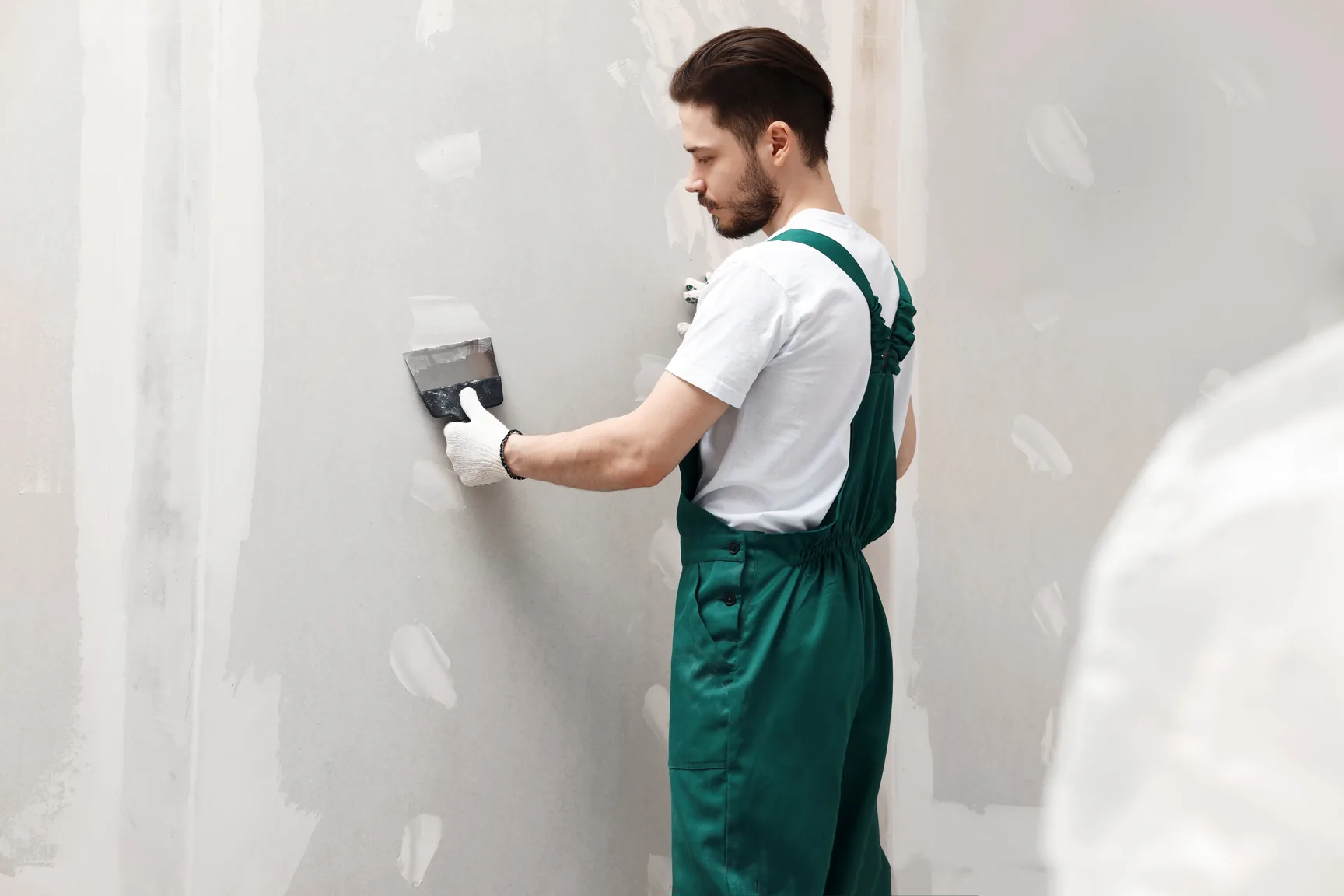
To bid a drywall job in Nevada, a business first needs a license from the State Contractors’ Board, and that holds for a subcontractor as much as for the firm running the project. Lead-safe renovation certification for older painted walls comes from EPA. The state’s asbestos rule exempts drywall joint compound from its licensing and project requirements only while the compound is not sanded, power sawed, drilled or otherwise made friable. Workers’ compensation is compulsory for covered employers and is bought from a private carrier or carried as an approved self-insurer, because there is no state fund.
The asbestos finding turns on the tools in the crew’s hands, not on paperwork, and the licensing finding turns on which of several classifications fits the work. Both are set out below in the record’s words.
How the policies themselves answer for a drywall business is the subject of the drywall contractor insurance page and the coverage pages it links to. Repair and remodeling work in occupied homes has its own page, residential drywall contractor insurance, and so does hanging and finishing under a general contractor, commercial drywall contractor insurance. This page keeps to what Nevada adds.
A stack of layers, read from top to bottom. At the top is the license from the state contractors board, which a subcontractor or specialty contractor needs as much as a general contractor before bidding or working. Below it is the classification on that license: the board may hold a licensee to the field it is classified in, and drywall appears under carpentry and minor repairs, under painting and decorating beside taping and finishing, and under lathing and plastering. Next is the proof of industrial insurance for employees that the board asks for before it grants or renews a license. Below that is the federal lead-safe renovation certificate for paid work that disturbs paint in older homes, child care facilities and preschools. Next is the asbestos rule’s exemption for drywall joint compound, which holds only while the compound is not sanded, power sawed, drilled or otherwise made friable. Below it is the asbestos license the industrial relations division issues, needed once the exemption ends and the work is a project for the control of asbestos. At the bottom is workers’ compensation, compulsory for covered employers, with a subcontractor’s workers counted as the principal contractor’s employees. No figures are shown.
Hanging, taping, plastering: drywall in the board’s classification list
Nevada licenses drywall contractors statewide through the State Contractors’ Board. A contractor under the statute includes a subcontractor or specialty contractor, and acting as a contractor or bidding a Nevada job without an active license is unlawful unless an exemption applies. The Board’s regulations name drywall in three specialty classifications: a drywall subclassification of carpentry, maintenance and minor repairs that covers installing, taping and finishing drywall with sheet-metal studs and acoustical tile; drywall and taping-and-finishing subclassifications of painting and decorating; and a drywall subclassification of lathing and plastering, whose other subclassifications cover lath, plaster and sheet-metal studs.
Authority: NRS 624.020(3); NRS 624.031(6); NRS 624.220(1); NRS 624.256(1)(a); NRS 624.700(1); NAC 624.210(2)(e); NAC 624.220(2)(c), (e); NAC 624.340(1), (2)(b), (c)
The license requirement starts with who counts as a contractor. The statute does not stop at the firm that signs with the owner:
“A contractor includes a subcontractor or specialty contractor,”
So a hanging or taping crew working under a general contractor needs a license of its own. The harder question for a drywall firm is which license. The board’s regulations write drywall into the carpentry classification, where it covers board, sheathing, acoustical tile and the sheet-metal studs behind them:
“DRYWALL (subclassification C-3e): The installation, taping and finishing of drywall, panels and assemblies of gypsum wallboard, sheathing, acoustical tile and studs made of sheet metal for the framing of ceilings and nonstructural partitioning.”
The painting and decorating classification carries its own drywall subclassification, and beside it a taping and finishing subclassification written for the finish trade alone:
“DRYWALL (subclassification C-4e): The installation and coating of gypsum wallboard and sheathing, including the installation of a system of suspended ceilings made of gypsum wallboard.”
“TAPING AND FINISHING (subclassification C-4c): The taping and finishing of the surfaces of wallboard and sheathing to create a permanent surface.”
Lathing and plastering, a specialty of its own, repeats that drywall entry word for word. The classification is not a label for the wall certificate. The statute lets the board hold a licensee to it, since the board
“may limit the field and scope of the operations of a licensed contractor to those in which the contractor is classified and qualified to engage”
As advice, read your license against the jobs you actually sell. A firm that hangs board on metal studs and a firm that only tapes and finishes may fit different entries. If a bid sits near the edge of yours, ask the board before the proposal goes out.
A repair exemption with a value cap, and the conditions that cancel it
A Nevada drywall business holds a Contractors’ Board license in the classification that fits its work before it bids or hangs board, because the Board may confine a licensee to the field and scope it is classified in. Before granting or renewing the license the Board requires proof of industrial insurance covering the applicant’s employees, or one of the statute’s alternatives. The statute’s small repair and maintenance exemption has a value cap and does not reach work that needs a building permit or work done by a licensee, so it is quoted below rather than paraphrased.
The exemption reads this way:
“Any work to repair or maintain property the value of which is less than $1,000, including labor and materials, unless:”
The first of the conditions that end it is the one a drywall firm meets most often:
“A building permit is required to perform the work;”
For a working drywall business, the exemption is narrow. Work done by a licensee falls outside it, so a firm that already holds a license cannot lean on it for the small jobs, and any job that needs a building permit takes it away whatever the price. As advice, do not build a line of business around the exemption, and do not let a crew lead price a patch job as exempt without checking whether a permit is involved.
The license also carries an insurance condition. Before it grants or renews a license, the board asks for
“Proof of industrial insurance and insurance for occupational diseases which covers the applicant’s employees;”
That makes workers’ compensation a licensing question as well as an employment one. The proof of insurance a general contractor asks for before a commercial project, and the additional insured wording that tends to come with it, is covered on the commercial drywall contractor insurance page.
Why the state’s lead work is about children’s blood tests, not renovators
Nevada is not an authorized RRP state, so EPA administers the lead renovation, repair and painting program there, and a drywall firm paid to disturb paint in older homes, child care facilities and preschools gets its lead-safe certification from EPA. EPA also runs the lead abatement and evaluation program in Nevada.
Authority: 40 CFR Part 745, Subpart E (RRP); 40 CFR Part 745, Subpart L; NRS 442.700
The federal requirement is written around paid work, which is every job a drywall firm takes:
“In general, anyone paid to perform work that disturbs paint in housing and child-occupied facilities built before 1978 must be certified in lead-safe work practices.”
Nevada’s own lead work sits with the Division of Public and Behavioral Health, which tracks children’s blood lead testing under state law rather than certifying renovation firms. Cutting out, patching or sanding painted walls and ceilings in older housing brings the federal renovation rule into play.
The state’s own lead work, run by the Nevada Division of Public and Behavioral Health, is a reporting duty on the people who test children’s blood:
“Per NRS 442.700, blood lead test results for children under 18 years of age must be reported to the appropriate health authority”
So the certificate a renovation firm holds here is federal. As advice, put the building’s age, its use and the certified renovator’s name on the estimate sheet before a crew cuts or sands an older painted wall; the residential drywall contractor insurance page spends time on why older homes raise those questions.
A joint compound exemption that ends at the sander
Nevada’s asbestos law is run by the Division of Industrial Relations, whose Occupational Safety and Health Administration enforces it: no one may engage in a project for the control of asbestos without a Division license, and control of asbestos includes repairing, renovating or demolishing a building that contains asbestos-containing material. The Division’s rule names drywall joint compound outright, as one of the nonfriable materials whose abatement is exempt from the state licensing and project rules, but only while the work follows the federal standards and the material is not sanded, power sawed, drilled or mechanically made friable.
Authority: NRS 618.069; NRS 618.750(2); NRS 618.755(1); NRS 618.790; NAC 618.008; NAC 618.875; NAC 618.894; NAC 618.9005; NAC 618.951; NAC 618.961; NAC 624.585(1)
Start with the rule’s own words. The exemption names the finisher’s material outright:
“Activities for the abatement of asbestos involving vinyl asbestos tile, exterior asbestos roofing material, exterior asbestos siding, drywall joint compound and other nonfriable materials containing asbestos are exempt from the requirements of NAC 618.850 to 618.986, inclusive.”
It is conditional, and the conditions are written for the tools a drywall crew uses. The work must follow the federal asbestos standards:
“To remain eligible for the exemption set forth in subsection 1, the activities must be performed in accordance with 29 C.F.R. § 1910.1001 and 29 C.F.R. § 1926.1101,”
and the material must be
“Not sanded, power sawed or drilled;”
and
“Not worked on or otherwise manipulated through the use of any mechanical means which would result in any nonfriable materials containing asbestos becoming friable.”
The rule’s test for friable is the familiar one, and it explains why sanding matters so much. Sanding turns a hard, painted seam into exactly the kind of material the definition describes:
““Friable material containing asbestos” means a substance containing asbestos which can be crumbled, pulverized or reduced to powder by hand pressure.”
The rule’s own words decide the reach, and here they name the material: the Division’s regulation lists drywall joint compound among the nonfriable asbestos materials whose abatement is exempt from the state licensing and project rules, on conditions. The exemption holds only while the work follows the federal general-industry and construction asbestos standards and the material is not sanded, power sawed, drilled or mechanically made friable; once it is, the material falls back under the rule, which reaches friable material (crumbled by hand pressure) and surfacing material (sprayed or troweled on). Wallboard, gypsum board and plaster are not named in the rule or the statute. The statute’s definition of control of asbestos includes repair and renovation of a building that contains asbestos, and it does not apply to a person working in his or her own residence. A separate statute section exempts a utility worker’s installation or removal of a small section of drywall in an emergency, which does not reach a drywall contractor.
As advice, ask the building owner for any asbestos inspection before you price tear-out or ceiling scraping, and read what it says about the surfaces you will touch.
Past the exemption: project size, the asbestos license and the own-home line
Taking out old drywall finished with joint compound by hand, wetted and in large pieces, stays inside the exemption; sanding, sawing or grinding it ends the exemption, and work above the rule’s project size then needs a Division-licensed asbestos contractor. A Contractors’ Board licensee without the asbestos removal classification is capped at the small quantities quoted below. The law does not apply to a person controlling asbestos in his or her own residence.
The statute’s licensing rule is short:
“A person shall not engage in a project for the control of asbestos unless the person holds a valid license issued by the Division.”
and the control of asbestos it licenses includes ordinary renovation work:
“The repair, renovation or demolition of a building or structure containing asbestos or materials containing asbestos; or”
The rule sets the size at which abatement becomes a project:
““Project for the abatement of asbestos” means any activity for the abatement of asbestos involving more than 25 linear feet of material containing asbestos located on pipes or ducts or more than 10 square feet of any other material containing asbestos.”
The contractors board adds a cap of its own for a licensee without the asbestos removal subclassification, which may not
“Remove more than 25 linear feet or 10 square feet of asbestos-containing material, as defined in 29 C.F.R. § 1926.1101(b); or”
And the statute sets aside a single situation entirely:
“The control of asbestos by a person in his or her own residence.”
Read those words closely. They speak of a person working in their own residence. As advice, do not take them as permission for a hired drywall firm to treat a homeowner’s job the same way, and ask the Nevada Division of Industrial Relations, Occupational Safety and Health Administration if a job sits near that line.
A few habits follow from the rule:
- Decide the removal method before the bid and write it into the proposal. Large pieces taken out by hand and kept wet is a different job, under the rule, from a wall ground down with a sander or cut with a power saw.
- If the work will cross the exemption’s line, schedule a licensed asbestos contractor for that part and bring your crew in after it.
How a liability policy treats a claim involving asbestos, and how finished work is treated once the owner is using the room again, are questions for the general liability page.
Compulsory comp, bought from a private carrier or carried as a self-insurer
Workers’ compensation is compulsory in Nevada for every employer the industrial insurance chapters cover: such an employer shall provide and secure compensation, and the chapters’ terms are conclusive, compulsory and obligatory on employers and employees alike. The insurers the law recognizes are private carriers, self-insured employers and associations of self-insured employers; there is no state fund to buy a policy from.
Authority: NRS 616A.020(2); NRS 616A.210(1); NRS 616A.270; NRS 616B.603(3)(a); NRS 616B.612(1)
The duty is stated plainly in the statute:
“Every employer within the provisions of chapters 616A to 616D, inclusive, or 617 of NRS, and those employers who accept the terms of those chapters and are governed by their provisions, shall provide and secure compensation …”
Subcontractors, independent contractors and their employees are deemed employees of the principal contractor for workers’ compensation, and the statute’s independent-enterprise exception does not apply to a principal contractor licensed by the Contractors’ Board, so a drywall contractor that subcontracts hanging or finishing answers for those crews unless they carry their own coverage.
The deeming rule is the part that reaches a drywall firm hardest, because hanging and finishing are so often subcontracted:
“subcontractors, independent contractors and the employees of either shall be deemed to be employees of the principal contractor for the purposes of chapters 616A to 616D, inclusive, of NRS.”
As advice, collect a current certificate from every subcontractor before it starts, and expect the premium audit to ask about anyone who worked on your jobs without one. The workers’ compensation page sets out how a policy treats crews paid by the board, the foot or the job. Nothing verified here crosses a state line.
A licensing board, a safety division and an insurance regulator
The Nevada Division of Insurance regulates insurance in the state; its role, as the record states it, is insurance regulator; authorizes the private carriers that write workers’ compensation and approves self-insured employers and associations. You can look up an insurance agency’s license, ours included, on NIPR.com.
The other offices this page draws on each hold a separate piece of the work. Each link goes to the office’s own site:
- State Contractors’ Board: statewide contractor licensing, including the drywall subclassifications of the carpentry, painting and decorating, and lathing and plastering classifications
- Nevada Division of Industrial Relations, Occupational Safety and Health Administration: asbestos consultant, contractor, supervisor and worker licensing, project notification and enforcement of the state asbestos rule
- Nevada Division of Industrial Relations, Workers’ Compensation Section: employer coverage requirements, posting requirements and the uninsured employers claim account
- Nevada Division of Public and Behavioral Health: state blood lead testing and reporting (NRS 442.700); lead-safe renovation certification is EPA’s
The state’s metro areas, none of them reaching across a border
The metro areas below are the metropolitan areas with a Nevada county, as the U.S. Census Bureau delineates them. The board license is statewide and goes with your business into each of them.
Las Vegas-Henderson-North Las Vegas, NV
Nevada counties in this metro, as the Census Bureau lists them: Clark County.
Reno, NV
Nevada counties in this metro, as the Census Bureau lists them: Lyon County, Storey County and Washoe County.
Carson City, NV
Nevada counties in this metro, as the Census Bureau lists them: Carson City.
As advice, track the county and city of every job even with a statewide license in hand, and ask the local building office whether the work needs a permit, since a permit ends the small-repair exemption.
Insurance behind the license, the exemption and the comp duty
The findings above tell you where Nevada’s rules sit. The coverage that answers for the work itself is the set of policies a drywall business carries wherever it works, and each has its own page:
- General liability for injury and damage to others, including how tear-out and finished work are treated.
- Workers’ compensation for the crew, and for the subcontracted crews the law can put on your payroll.
- Commercial auto for the trucks that haul board, mud and scaffolding between the supply yard and the job.
- Inland marine coverage for tools and equipment for the lifts, banjos, boxes and sanders that move from site to site.
- Umbrella liability for limits above the primary liability policies, often written into a general contractor’s subcontract.
- Commercial property for the shop and the stock kept in it.
Which of those matter most depends on the work, and the service pages take residential and commercial drywall work each on its own terms.
State rules decide who may do the work and how; the policies decide who pays when something goes wrong.
- A license, registration or certification is a requirement of the state, not insurance.
A panel for Nevada in rows. Each row sets a requirement of the state beside the exposure that requirement leaves open and the coverage line that answers it. Contractor license: A state license or registration reaches drywall work. It leaves open injury and damage to others from the work, during the job and after it, which General Liability answers. Lead-safe renovation: The federal program runs lead-safe renovation here. It leaves open paint dust disturbed when older walls are cut, patched or sanded, which General Liability answers. Asbestos in wall and ceiling material: A state program reaches removal of this material. It leaves open disturbing older joint compound, wallboard or plaster, which General Liability answers. Workers’ compensation: Required for covered employers, bought in the open market. It leaves open a crew member hurt on the job, which Workers’ Compensation answers. Notes: A license, registration or certification is a requirement of the state, not insurance. The conclusion reads: State rules decide who may do the work and how; the policies decide who pays when something goes wrong. No figures are shown.
Nearby states we also write
Nevada coverage, services and state offices
What we insure
Coverage lines
Nevada drywall contractor insurance questions
Our crews only finish seams on board that other companies put up. Is that a different classification from hanging?
It can be. The State Contractors’ Board’s regulations give taping and finishing its own subclassification, and they name drywall work in more than a single place: a drywall subclassification of carpentry, maintenance and minor repairs; drywall and taping-and-finishing subclassifications of painting and decorating; and a drywall subclassification of lathing and plastering. The board may limit a licensee to the field it is classified in. As advice, compare each scope you sell with the regulation’s words and ask the board before you bid work that sits near the edge of your classification.
We sometimes do touch-up work for a builder after the inspection. Does the small-repair exemption cover those visits?
The statute’s repair and maintenance exemption has a value cap, and it ends when a building permit is required to perform the work or when the work is done by a licensee. As advice, treat any visit tied to a permitted project as licensed work, and keep the exemption for nothing you would have to defend later.
Can our finishers sand old joint compound during a remodel without bringing in an asbestos contractor?
Sanding is exactly what the exemption does not allow. The Nevada Division of Industrial Relations, Occupational Safety and Health Administration’s rule exempts abatement involving drywall joint compound and other nonfriable asbestos materials only while the work follows the federal asbestos standards and the material is not sanded, power sawed, drilled or mechanically made friable. Once the material is made friable, the exemption is gone, and a project for the control of asbestos needs the division’s license. As advice, find out what the compound contains before anyone picks up a sander.
Which certificate do we need before we cut into painted walls in a house built decades ago?
The lead-safe renovation certificate comes from EPA, which administers the renovation, repair and painting program in Nevada. The Nevada Division of Public and Behavioral Health handles blood lead testing and reporting, not renovation firm certification. As advice, put the age of the building on every estimate so the question gets asked before the crew arrives.
Our hanging subcontractor says its people are independent. Does that keep them off our comp policy?
Not by itself. The statute deems subcontractors, independent contractors and their employees to be employees of the principal contractor for workers’ compensation, and its independent-enterprise exception does not apply to a principal contractor licensed by the contractors board. As advice, collect a current certificate from every subcontractor before it starts and keep it with the job file.
Why does the licensing board want to see our workers’ compensation before it renews us?
Because the statute asks for it. Before granting or renewing a license, the State Contractors’ Board requires proof of industrial insurance covering the applicant’s employees, or an alternative the statute allows. As advice, keep the proof current with your renewal calendar so a lapse in coverage never becomes a lapse in the license.
Could a drywall company carry its own comp risk instead of buying a policy?
The comp law recognizes self-insured employers and associations of self-insured employers beside private carriers, and the Nevada Division of Insurance approves the self-insurers and authorizes the carriers. There is no state fund an employer buys from. As advice, ask the division what qualifying would take before you plan around it. You can also look up an insurance agency’s license, ours included, on NIPR.com.
This page describes insurance for drywall contractors operating in this state. It is general information, not legal advice and not a statement of coverage. Licensing, lead-safe and asbestos requirements change; verify current requirements with the agency named before relying on them.
Get a quote for your Nevada drywall work
Tell us the classifications on your license, whether your crews sand or saw old finishes, and who works for you or under you, and we will shape the coverage to that work.