
Drywall Contractor Insurance by State
Arkansas Drywall Contractor Insurance
Arkansas names drywall in the specialty lists of its contractors board and that board’s residential committee, leaves lead-safe renovation certification to EPA, runs its own asbestos rule and reaches building crews with a compulsory workers’ compensation law.
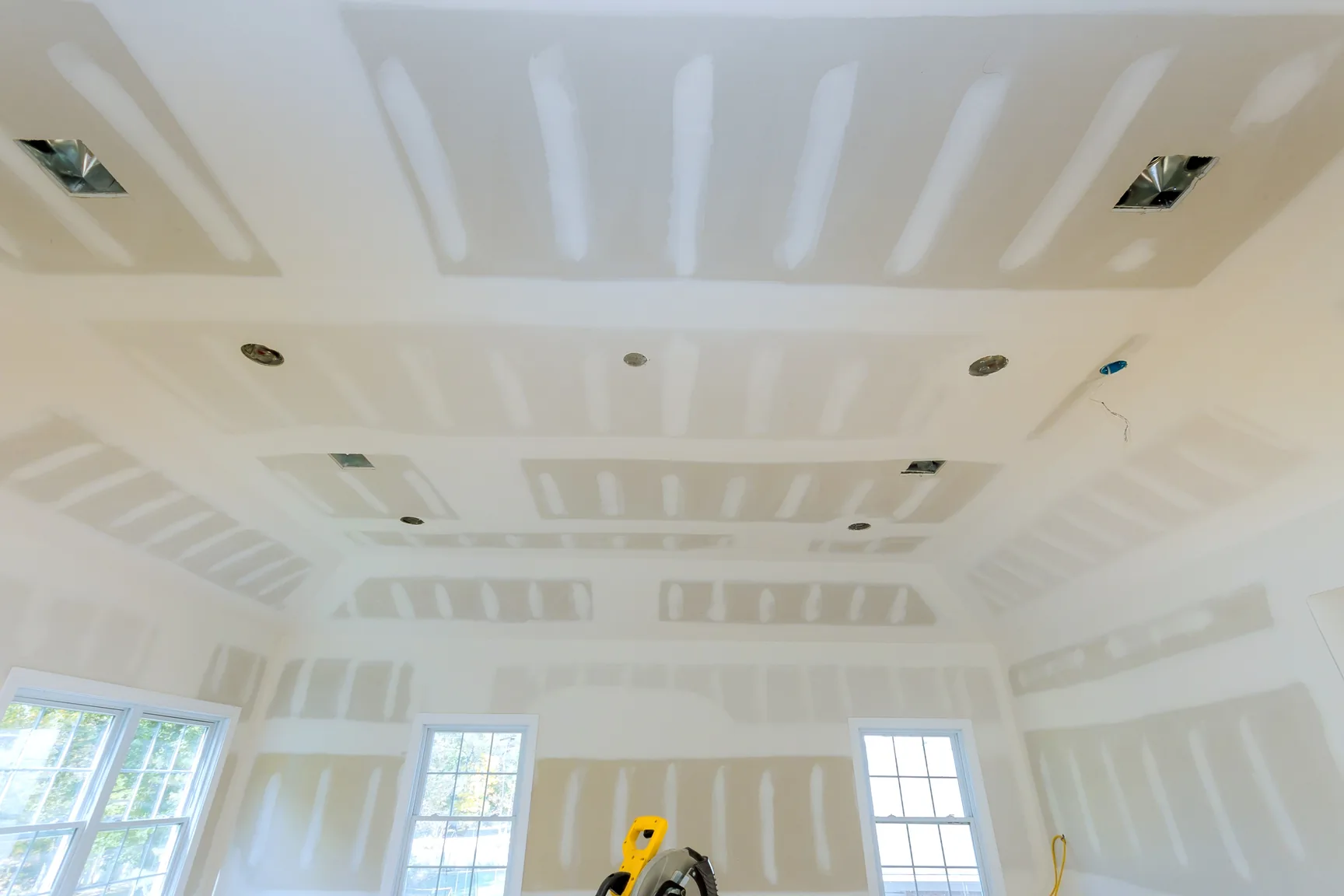
In Arkansas, drywall is a licensed specialty by name, on the commercial side and again on the residential side. The Arkansas Contractors Licensing Board lists it as a specialty for commercial projects above the contract amount its law sets, and the Board’s residential committee lists it for home improvement work on single-family houses above a much lower cost line. Lead-safe renovation certification for older painted walls comes from EPA, while the state’s own asbestos rule, run by the Division of Environmental Quality, reaches tear-out in commercial and larger residential buildings. Workers’ compensation is compulsory for the employers the law covers, and building work is reached at a smaller crew than most employment.
Which license fits depends on the building, the size of the job and who signed the contract, and the sections below take those questions in the order a job meets them, with the source’s own words where they settle a point.
How the policies themselves work for a drywall business is set out on the drywall contractor insurance page and the coverage pages it links to. This page stays with what is particular to Arkansas, whether your crews patch, texture and refinish walls in occupied homes, which the residential drywall contractor insurance page covers, or hang and finish board on build-outs for general contractors, which belongs to the commercial drywall contractor insurance page.
A cascade read from top to bottom, each step holding what the step above it hands down. At the top is a drywall job priced anywhere in the state, and both of the Board’s rule lists, commercial and residential, name drywall as a specialty. The next step sorts the building: the Board treats any project that is not a single-family residence as commercial, and single-family work goes to its residential committee. The step after that asks whether the job sits above the cost line the law sets for that side, and a job under the line drops out of the license duty. Then comes the question of who the firm works for. On commercial work, a subcontractor of a properly licensed prime may hold a registration in place of a full license; on a house, a subcontractor of a committee licensee is exempt. What reaches the next step is a license or registration carrying a classification, and a residential specialty license reaches only the specialty it names. At the bottom sits the workers’ compensation coverage the law requires, with proof the Board asks for before it issues or renews. No figures are shown.
Commercial projects: the contract-amount line and a drywall classification
Arkansas licenses drywall contractors statewide through the Arkansas Contractors Licensing Board. On commercial work above the cost line set by law, a contractor needs a commercial license, or a subcontractor registration when working under a properly licensed prime contractor, and drywall is one of the specialty classifications the Board’s rules list. On single-family homes, the Board’s Residential Contractors Committee licenses home improvement contractors above a much lower cost line, and its specialty list names drywall, lath and plaster, and metal studs.
A drywall firm needs the license or registration carrying the classification that matches the job before it bids or works on a project above the cost line the law sets, and the Board requires proof of workers’ compensation coverage, where the law requires that coverage, before it issues or renews one.
Authority: Ark. Code Ann. § 17-25-101; Ark. Code Ann. § 17-25-103; Ark. Code Ann. § 17-25-316; 17 CAR § 255-308; Ark. Code Ann. § 17-25-505; Ark. Code Ann. § 17-25-513; 17 CAR § 295-110; 17 CAR § 295-111
The commercial law draws its line by the size of the job. As the Board reprints the statute, the violation is doing the work above a stated contract amount without the right paper, and the sentence ends this way:
“… is fifty thousand dollars ($50,000) or more, without first having procured a license or registration with the proper classification to engage in the business of contracting in this state.”
Notice the last words: the proper classification. A license carries classifications, and on the Board’s commercial list of specialties drywall is its own entry:
“(23) Drywall;”
What counts as commercial is broader than an owner might guess, and the Board’s guidance settles it plainly:
“Any project that is not a single-family residence is a commercial project.”
A drywall firm that works under someone else’s prime contract has a lighter route, which the Board describes in its guidance with capital letters of its own:
“Subcontractors of PROPERLY LICENSED contractors can work with a REGISTRATION certificate instead of a full license.”
The condition in that sentence is the prime contractor’s license, not yours. As advice, a sub that relies on a registration should see the prime’s license before it signs, and should price each job against the Board’s current reprint of the law, counting change orders that could carry a contract over the line.
The certificates of insurance and additional insured wording a general contractor asks for before a commercial job are taken up on the commercial drywall contractor insurance page.
Single-family houses: the residential committee’s license and its specialty list
Houses run on a separate track, through the Board’s residential committee rather than its commercial side. The residential law states the duty plainly:
“(b) A person shall not act as a home improvement contractor after January 1, 2012, unless: (1) Licensed by the committee; or (2) Exempt from licensure under this subchapter.”
The law’s exemption list sets the small-job line, and it adds a second exemption that matters to any drywall firm working for a builder or remodeler:
“A person or entity acting as a residential building contractor or a home improvement contractor on any project, when the cost of the work done or to be done does not exceed two thousand dollars ($2,000).”
“(4) A subcontractor of a contractor licensed by the Residential Contractors Committee; and”
The committee’s rules then list the specialties a home improvement license can carry. Drywall is there by name:
“(L) Drywall;”
So are the neighboring trades a drywall crew sometimes drifts into on an older house, each as its own entry:
“(V) Lathe, plaster, stucco, Dryvit, and EIFS; (W) Masonry; (X) Metal studs, walls;”
Separate entries matter because the rules hold a specialty licensee to the specialty it holds:
“(2) A contractor licensed as a residential specialty contractor is authorized to only perform the functions of the specific specialty for which a license is held.”
As advice, read that rule against your real scope. A firm licensed for drywall that also repairs old plaster or frames partitions in metal studs should ask the committee whether those jobs need classifications of their own, before the work rather than after a complaint.
Older painted walls: EPA certifies the renovator, the health department licenses abatement
Arkansas is not an authorized RRP state: EPA administers the lead renovation, repair and painting (RRP) program there, so the lead-safe certification a drywall firm needs for paid work that disturbs paint in older homes and child-occupied facilities comes from EPA.
Authority: 40 CFR Part 745; Arkansas Code § 20-27-2501 et seq.
Cutting out a damaged section, opening a wall for a doorway or sanding a patch flush disturbs whatever paint is on the wall. The federal rule is written around exactly that kind of paid work:
“In general, anyone paid to perform work that disturbs paint in housing and child-occupied facilities built before 1978 must be certified in lead-safe work practices.”
The Arkansas Department of Health runs the state’s own lead-based paint program, which certifies, licenses and sets training requirements for people and firms doing lead-based paint abatement, and the department says it is not responsible for EPA’s renovation rule. Cutting out or sanding painted walls in an older home brings the federal renovation rule into play; abatement work brings in the state program.
The Arkansas Department of Health draws the line itself, in a note on its own program page:
“Note: ADH is not responsible for EPA’s Renovation, Repair and Painting (RRP) Rule.”
Its program covers different ground, set by a state regulation that the department describes as one
“… which sets forth certification, licensing, and training requirements for those persons and firms who perform lead-based paint abatement activities and training in the state of Arkansas.”
For an owner the split is simple: renovation certification is federal, and abatement licensing is the state’s. As advice, put the building’s age and the painted surface the crew will cut or sand on the estimate sheet, and know who in the business holds the EPA certification and whether that person will be on the job.
How a liability policy treats a claim that involves lead dust is a separate question, taken up on the general liability page.
Asbestos: the Division stands where the federal agency stood
Arkansas’s Asbestos Abatement Rule, administered by the Division of Environmental Quality, reaches drywall tear-out in commercial and larger residential buildings. The state adopts the federal asbestos emission standard into its own rule and reads every reference to EPA as a reference to the Division, so the state, not EPA, runs the program. The rule names drywall and wallboard by word, in its list of small-scale short-duration tasks, and otherwise reaches old wall and ceiling material through its friable and nonfriable categories. A thorough asbestos inspection comes before any renovation of a covered facility, and the rule’s definition of a facility leaves out residential buildings with a small number of dwelling units.
Authority: 20 CAR § 860-102; 20 CAR § 860-104; 20 CAR § 860-105; 20 CAR § 860-107; 20 CAR § 860-1705; Arkansas Code § 20-27-1001 et seq.; 40 CFR 61, Subpart M
Start with who is in charge, because that decides where a question goes. The rule states its purpose in terms of a state program:
“Administer and enforce a program for the licensing of asbestos abatement contractors …”
It takes in the federal asbestos emission standard and then swaps the federal agency out of it, in a single line:
“All reference to the United States Environmental Protection Agency shall be considered a reference to the Division of Environmental Quality.”
In practice, that means asbestos notices, licenses and questions about a tear-out go to the Division of Environmental Quality, not to a federal regional office. As advice, keep the Division’s rules page, linked in the list of offices below, with the rest of your bid documents.
Small sections of drywall, larger tear-outs and the homes the rule leaves out
The rule names the trade’s own material, but in a narrow place: its definition of small-scale short-duration activities, the small tasks it treats differently from full abatement.
““Small-scale short-duration (SSSD) activities” means tasks including, but not limited to: … (iv) Installation or removal of a small section of drywall”
“(iv) Repairs to a piece of asbestos-containing wallboard”
Those are the only places the rule uses either word, and it never names joint compound or plaster. Larger jobs are reached through its categories. Material that does not crumble by hand can still be regulated, because the rule looks at what renovation will do to it:
“Category II nonfriable ACM that has a high probability of becoming or has become crumbled, pulverized, or reduced to powder by the forces expected to act on the material in the course of demolition or renovation operations regulated by this part”
The rule puts the inspection before the work and assigns it to the owner or operator:
“The owner or operator of a demolition, renovation, or response action shall conduct, or have conducted, a thorough inspection of the affected facility or part of the facility for the presence of asbestos”
Once regulated material is involved, the people handling it need the rule’s credentials:
“A person must meet the licensing and/or certification provisions of this part prior to engaging in renovations, demolitions, or response activities involving RACM”
The exclusion for small residential buildings sits inside the definition of a facility, in the rule’s own words:
“Institutional, commercial, public, industrial, school, or residential structure, installation, or building, including any structure, installation, or building containing condominiums or individual dwelling units operated as a residential cooperative, but excluding residential buildings having four (4) or fewer dwelling units”
Read that exclusion carefully. It takes small residential buildings out of the rule’s definition; it does not say what is in a particular ceiling, and a crew still chooses how it takes down a finish it has not had tested. As advice, ask for the inspection before you price a demolition, do not stretch the small-task definition to fit a job that has grown, and if regulated material has to come out without the state’s license in your business, schedule a licensed abatement contractor first and your crew after it.
Whether a liability policy answers a claim that involves asbestos, and how finished work is treated once a room is back in use, are questions for the general liability page.
A comp law that reaches building crews at a smaller size
Workers’ compensation is compulsory in Arkansas for the employers its law covers, and building work is reached at a smaller crew size than most employment. Coverage comes through a workers’ compensation insurance policy or through state approval to self-insure; there is no state fund for private employers.
Authority: Ark. Code Ann. § 11-9-102; Ark. Code Ann. § 11-9-402; Ark. Code Ann. § 11-9-404; Ark. Code Ann. § 17-25-316
The Arkansas Workers’ Compensation Commission gives the general rule on its basic facts page:
“Most employers in Arkansas with three or more employees are required by law to have Workers’ Compensation insurance coverage for their employees.”
The word most is doing work there. The Commission’s own application form for a certificate of non-coverage lists the employments the law reaches, and the building trades sit on a line of their own:
“(b) in which two (2) or more employees are engaged in building or building repair work;”
“(c) in which one (1) or more employee is employed by a contractor who subcontracts any part of his contract;”
For a drywall business, that is the line to read first. Hanging, taping and repair are building work, and a firm that subcontracts any part of a job is reached at the smallest count on the form. As advice, do not measure your business against the general rule on the facts page; measure it against the building line.
The Commission names the ways an employer meets the duty:
“The coverage is provided through a Workers’ Compensation insurance policy or by the employer receiving state approval to be self-insured for such purposes.”
Neither route runs through a state insurer. Coverage is bought from the private market or carried under the state’s approval to self-insure. The licensing law ties the duty back to the Board as well:
“(a) A contractor required to be licensed or registered by the Contractors Licensing Board shall obtain and maintain workers’ compensation coverage as required under the Workers' Compensation Law, § 11-9-101 et seq.”
A drywall contractor licensed or registered by the Contractors Licensing Board must carry the coverage the workers’ compensation law requires and keep proof of it on file with the Board.
Hangers paid by the board, finishers brought in under a separate business and the certificates those crews should hand you are policy questions more than Arkansas questions, and the workers’ compensation page sets them out.
Licensing, health, environment and comp: the agency behind each answer
The Arkansas Insurance Department is the state’s insurance regulator. You can look up an insurance agency’s license, ours included, on NIPR.com.
The other bodies this page draws on each hold a separate piece. Each link goes to the agency’s own site, and each role is described as the record verified it:
- Arkansas Contractors Licensing Board: statewide commercial contractor licensing and subcontractor registration; its Residential Contractors Committee licenses residential builders, remodelers and home improvement contractors
- Arkansas Department of Health: state lead-based paint program (abatement certification, licensing and training); RRP itself is EPA-administered
- Division of Environmental Quality: state environmental agency, within the Arkansas Department of Energy and Environment
- Division of Environmental Quality asbestos program: asbestos abatement licensing and certification, inspection and notification rules, and work practices under the Asbestos Abatement Rule
- Arkansas Workers’ Compensation Commission: workers’ compensation administration, coverage compliance and self-insurance approval
Markets for a statewide license, read county by county
The metro areas below are the largest metropolitan areas whose principal cities are in Arkansas, followed by a cross-border metro that takes in an Arkansas county, as the U.S. Census Bureau delineates them. The contractor license is statewide, so the same license and classifications travel with a crew across all of them.
Little Rock-North Little Rock-Conway, AR
Arkansas counties in this metro: Faulkner County, Grant County, Lonoke County, Perry County, Pulaski County and Saline County.
Fayetteville-Springdale-Rogers, AR
Arkansas counties in this metro: Benton County, Madison County and Washington County.
Fort Smith, AR-OK
This metro reaches beyond Arkansas, and this card names only its Arkansas counties: Crawford County and Sebastian County.
Jonesboro, AR
Arkansas counties in this metro: Craighead County and Poinsett County.
Hot Springs, AR
Arkansas counties in this metro: Garland County.
Memphis, TN-MS-AR
This metro reaches beyond Arkansas, and this card names only its Arkansas counties: Crittenden County.
As advice, a statewide license does not settle every local question. Keep track of the city and county each job sits in, and ask the local building office about permits before the bid goes out.
Liability, comp, auto and tools: what the findings hand to the insurance side
A license, a renovator card and a comp filing do not answer for damage the work causes. That falls to the policies a drywall business carries wherever it works, and each has its own page:
- General liability for injury and damage to others, including finished work and tear-out.
- Workers’ compensation for the crew, including crews paid by the piece.
- Commercial auto for the trucks that haul board, mud and lifts between the supply house and the job.
- Inland marine coverage for tools and equipment for the lifts, banjos, stilts and sanders that move from site to site.
- Umbrella liability for limits above the primary liability policies, often asked for in a subcontract.
- Commercial property for the shop and what is stored in it.
Which of those carry the most weight depends on whether your crews patch walls in occupied houses or hang board on commercial build-outs. When you are ready to put the pieces together for Arkansas work, a quote request is the place to start.
State rules decide who may do the work and how; the policies decide who pays when something goes wrong.
- A license, registration or certification is a requirement of the state, not insurance.
A panel for Arkansas in rows. Each row sets a requirement of the state beside the exposure that requirement leaves open and the coverage line that answers it. Contractor license: A state license or registration reaches drywall work. It leaves open injury and damage to others from the work, during the job and after it, which General Liability answers. Lead-safe renovation: The federal program runs lead-safe renovation here. It leaves open paint dust disturbed when older walls are cut, patched or sanded, which General Liability answers. Asbestos in wall and ceiling material: A state program reaches removal of this material. It leaves open disturbing older joint compound, wallboard or plaster, which General Liability answers. Workers’ compensation: Required for covered employers, bought in the open market. It leaves open a crew member hurt on the job, which Workers’ Compensation answers. Notes: A license, registration or certification is a requirement of the state, not insurance. The conclusion reads: State rules decide who may do the work and how; the policies decide who pays when something goes wrong. No figures are shown.
Arkansas coverage, services and state offices
What we insure
Coverage lines
Arkansas drywall contractor insurance questions
Our crew hangs board on office build-outs for a general contractor. Is a full license the only way in?
Not always. The Arkansas Contractors Licensing Board says in its guidance that subcontractors of properly licensed contractors can work with a registration certificate instead of a full license, and its guidance treats any project that is not a single-family residence as commercial. Above the contract amount the commercial law sets, the license or registration has to carry the proper classification, and drywall is one of the specialties on the Board’s commercial list. As advice, confirm the prime contractor’s license before you rely on the registration route.
Most of our jobs are patch-and-finish work in houses. When does a home job need the residential committee’s license?
When its cost passes the line the residential law sets, labor and material included, as the Arkansas Contractors Licensing Board explains it. At or below that line the law exempts the job, and a subcontractor working for a contractor the residential committee has licensed is exempt as well. Above it, the home improvement license is the one the law names, and the committee’s specialty list includes drywall.
We also repair old lath and plaster walls and frame with metal studs. Does a drywall classification reach that work?
Probably not on a house. The residential committee’s specialty list names drywall, lath and plaster, and metal studs as separate entries, and its rules say a residential specialty licensee may perform only the functions of the specialty it holds. If those trades are a regular part of your work, ask the Arkansas Contractors Licensing Board which classifications your license should carry before you bid them.
The state health department runs a lead program. Is that where our renovation certificate comes from?
No. The Arkansas Department of Health licenses lead-based paint abatement and its training, and its own page says it is not responsible for EPA’s renovation, repair and painting rule. EPA runs that rule in Arkansas, so the lead-safe certification for paid work that disturbs paint in older homes and child-occupied facilities comes from EPA.
A building owner wants a small section of old drywall cut out and replaced. Does the asbestos rule treat a small job differently?
The rule lists the installation or removal of a small section of drywall, and repairs to a piece of asbestos-containing wallboard, as examples of small-scale short-duration activities, which it treats differently from full abatement. It still calls for an asbestos inspection before any renovation of a covered facility. As advice, ask the owner for that inspection before you price the cut, and put any question about how the small-task definition applies to the Division of Environmental Quality.
A landlord wants the ceilings scraped in a small apartment house. Is a building that size even inside the asbestos rule?
The rule’s definition of a facility leaves out residential buildings with a small number of dwelling units, and it states the count. Larger residential buildings, condominiums and commercial buildings are inside it. That is an exclusion from the state rule, not a finding about what is in a particular ceiling, so a crew still decides how it takes down a finish it knows nothing about.
Most days it is me and a helper hanging board. Does the comp law reach a crew our size?
It can. The Arkansas Workers’ Compensation Commission sets a smaller employee count for employment engaged in building or building repair work than for most employment, and a contractor who subcontracts part of a contract is reached at a smaller count again. The Arkansas Contractors Licensing Board also expects a licensed or registered contractor to carry the coverage the law requires. As advice, ask the Commission how your crew counts before you decide you are outside the law.
This page describes insurance for drywall contractors operating in this state. It is general information, not legal advice and not a statement of coverage. Licensing, lead-safe and asbestos requirements change; verify current requirements with the agency named before relying on them.
Get a quote for your Arkansas drywall work
Tell us whether you work on houses, commercial space or both, how your contracts are usually signed, how old the walls you open tend to be and who is on the payroll, and we will shape the program around those answers.