
Drywall Contractor Insurance by State
Missouri Drywall Contractor Insurance
Missouri leaves the contractor license to its cities and counties, sends lead-safe renovation to the federal agency, certifies asbestos work through its natural resources department and makes comp compulsory for construction employers.
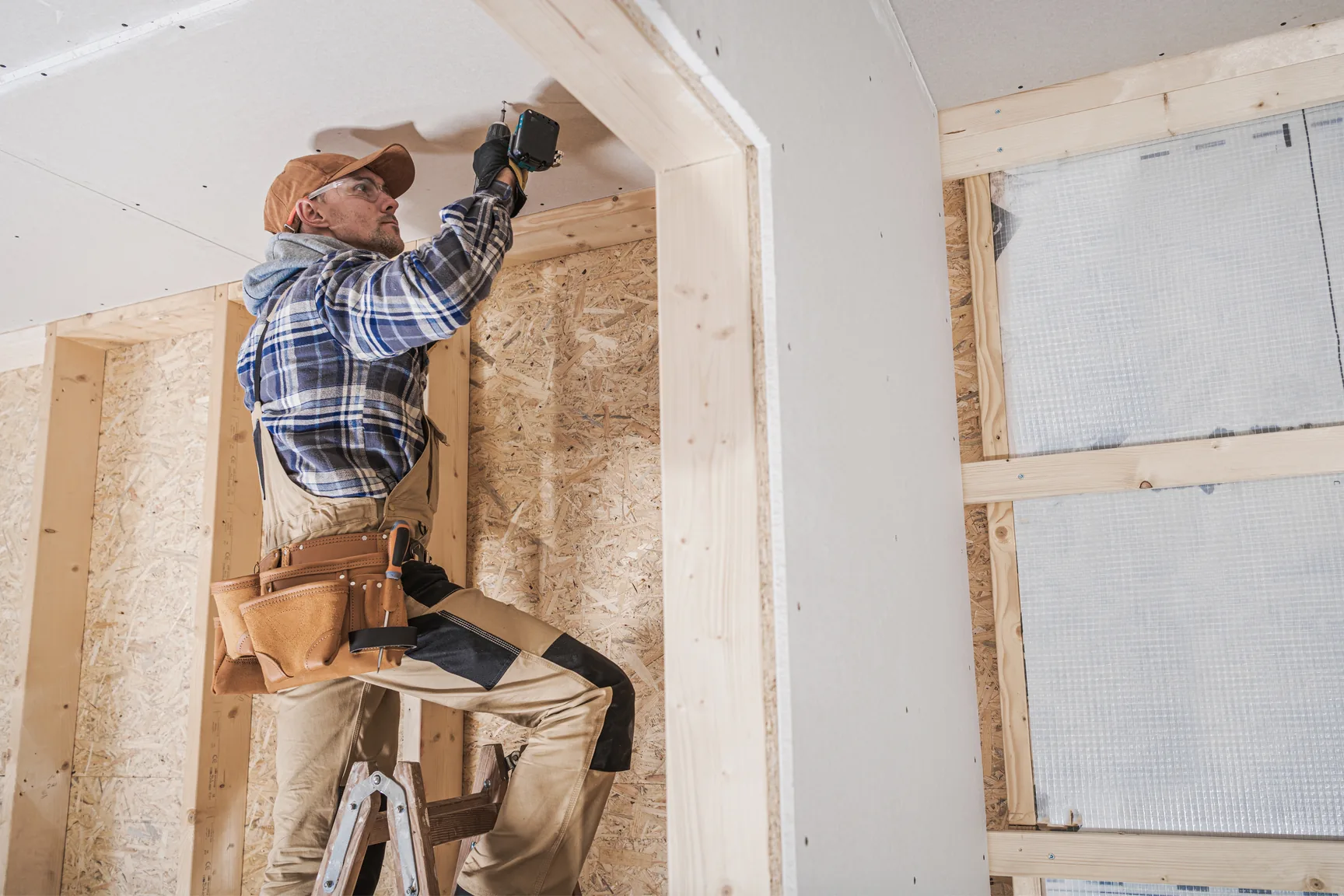
Missouri ties its local contractor licenses to workers’ compensation. The state itself issues no license that reaches drywall work, so the license question belongs to the city or county where a job sits, and any city or county that licenses construction contractors has to see proof of workers’ compensation coverage, or an affidavit of exemption, before it issues one. Lead-safe renovation certification comes from EPA. The Missouri Department of Natural Resources certifies the people who work on asbestos projects, and its guidance names joint compounds and textured paints among the materials that may contain asbestos. Workers’ compensation is compulsory, and the law reaches a construction employer as soon as it has an employee.
How the policies work for a drywall business in any state is set out on the drywall contractor insurance page, with repair work in occupied homes on the residential drywall contractor insurance page and subcontract work on builders’ projects on the commercial drywall contractor insurance page. What follows keeps to Missouri: each finding as the record verified it, in the statute’s or the agency’s own words where they carry the point.
A comparison in columns, read left to right. The federal column holds lead-safe renovation certification, which the federal environmental agency runs in Missouri for paid work that disturbs paint in older housing and child-occupied facilities. The state column holds the health department’s license for lead abatement work, enclosure included; the natural resources department’s certificate for asbestos projects, under a statute that reaches material that is sanded, cut or abraded or that the work is likely to crumble; and the compulsory workers’ compensation law, which reaches a construction employer as soon as it has an employee and is met through an authorized insurer or approved self-insurance, with no state fund. The local column holds the contractor license, since no state license reaches drywall work and a city or county may license or tax contractors, and the proof of workers’ compensation coverage that any city or county licensing a construction contractor must ask to see. No figures are shown.
A license tax on plasterers, and a city business license beside it
Missouri issues no statewide contractor license or registration that reaches drywall work. The Missouri Division of Professional Registration’s lists of boards and professions include electrical contractors and interior designers, and no general, building, home improvement, drywall or plastering contractor. The Missouri statutes leave contractor licensing to cities and counties: the law for one class of city lets its council levy a license tax on plastering contractors and all subcontractors, and regulate building contractors.
Authority: RSMo 94.110; RSMo 287.061
The statute the headline points to was written for a particular class of city. Its taxing power reaches the plastering trade by name and every subcontractor after it:
“The council shall have power and authority to levy and collect a license tax on … painting contractors, plastering contractors, and all subcontractors”
That line describes a power a particular kind of city holds, not what any given city has done with it. What it does show is where the licensing question lives in Missouri: with the local council, not a state board.
No state license is not the same as nothing being required. A city or county may license construction contractors, and the City of St. Louis requires a construction industry contractor business license; state law then requires any city or county that licenses a construction contractor to demand proof of workers’ compensation coverage, or an affidavit that the contractor is exempt, before it issues the license.
The City of St. Louis is the example the record verified: the city requires a construction industry contractor business license of construction contracting businesses, and asks for proof of workers’ compensation coverage before issuing it. Its license page puts it in a single sentence.
“Your business requires a Construction Industry Contractor Graduated Business License (GBL).”
That page names no trade, drywall included, so read it as a city license for construction contracting in general. As advice, look up the city and the county for every job before the bid goes out, keep a list of the places you hold a license with their renewal dates, and do not assume a general contractor’s local license stands in for your own.
The workers’ compensation certificate behind a local license
The most practical line in the licensing record sits in the workers’ compensation chapter, and it puts the comp question at the counter of every city or county that licenses construction contractors:
“Any city or county which issues an occupational or business license for a contractor in the construction industry shall require a certificate of insurance for workers' compensation coverage”
For a drywall business, the local license and the comp policy have to be lined up together, because the office will not issue the first without the second or an exemption affidavit. As advice, keep the current certificate where whoever handles licenses can reach it, and expect to show the new one when a license renews after the policy does. If you plan to file an exemption affidavit, read the comp section below first; the construction rule reaches a business early. How a comp policy is written and audited for a drywall payroll is on the workers’ compensation page.
Lead-safe work in older housing and in rooms children use
Missouri is not an authorized RRP state: EPA administers the lead renovation, repair and painting (RRP) program there, and the Missouri Department of Health and Senior Services says so on its own lead licensing page. The lead-safe certification a drywall firm needs for paid work that disturbs paint in older housing and child-occupied facilities comes from EPA.
Authority: 40 CFR Part 745; RSMo 701.312
The state’s lead licensing page draws the line in a section heading:
“Renovation, Repair and Painting: Regulated by the U.S. EPA”
It then says what those federal regulations are about, which fits a crew’s ordinary week of cutting, patching and sanding painted walls:
“These regulations focus on the use of lead safe work practices on all housing and child occupied facilities built prior to 1978.”
The federal agency’s own page states who needs the certification:
“In general, anyone paid to perform work that disturbs paint in housing and child-occupied facilities built before 1978 must be certified in lead-safe work practices.”
The other half is a state program run by the Missouri Department of Health and Senior Services, and it covers different ground.
Alongside the federal renovation rule, the Missouri Department of Health and Senior Services runs the state’s own lead program for abatement: it licenses lead abatement contractors, supervisors and workers, inspectors, risk assessors and project designers, and it says the renovation rule did not change who must be licensed for abatement. Tearing out painted walls in older buildings can bring the federal renovation rule into play, and work that amounts to abatement needs the state license.
“The RRP regulations have not altered federal or state regulations on lead abatement and anyone performing any abatement strategies (removal, replacement, enclosure and encapsulation) must still be licensed by Department of Health and Senior Services”
Notice enclosure in that list. Covering a wall is ordinary drywall work, and enclosing lead-based paint is named as an abatement strategy. Whether a particular job is abatement or renovation depends on what it is for and how it is scoped, and the record does not settle that for any particular job. As advice, when a customer asks you to cover painted walls because of lead, call the department before you bid. On any older building, write the building’s age, who lives or spends the day there and how much painted surface the crew will disturb onto the estimate, and know who holds the federal certification before the crew arrives. How a liability policy treats a claim involving lead is taken up on the general liability page.
Finishing work in the words of Missouri’s asbestos statute
Missouri’s asbestos law, administered by the Missouri Department of Natural Resources, reaches drywall tear-out through its material categories rather than by naming drywall: friable material that crumbles by hand pressure, and nonfriable material that is sanded, cut or abraded or that demolition or renovation is likely to crumble, is regulated material, and no one may work on an asbestos abatement project or inspection without the department’s certificate. The department’s guidance names joint compounds, spackling compounds, textured paints and acoustical plaster among potential asbestos-containing materials, and says its rules leave out most single-family homes.
Authority: RSMo 643.020; RSMo 643.225; 10 CSR 10-6.241; 10 CSR 10-6.250; 40 CFR Part 61, Subpart M
Start with the law itself. It defines the material it regulates by content, not by trade name:
“any material or product which contains more than one percent asbestos”
It then sorts that material by how it behaves. Material that falls apart under a hand is friable:
“asbestos that, when dry, can be crumbled, pulverized or reduced to powder by hand pressure”
Harder material is brought in by what the work does to it, and the verbs are a finishing crew’s:
“Category I nonfriable asbestos-containing material that will be or has been subjected to sanding, grinding, cutting, or abrading”
A second category reaches material that demolition or renovation is likely to break down:
“Category II nonfriable asbestos-containing material that has a high probability of becoming or has become crumbled, pulverized, or reduced to powder by the forces expected to act on the material in the course of demolition or renovation operations”
The law’s own words decide the reach, and the asbestos sections of the Missouri statutes never name joint compound, wallboard, gypsum board, drywall or plaster. They reach them through categories: material with asbestos in it that crumbles by hand pressure when dry, nonfriable material that is sanded, ground, cut or abraded, and nonfriable material that demolition or renovation is likely to crumble or pulverize. Sanding, cutting or tearing out an old finish is the kind of force those definitions describe. The department’s guidance is where joint compounds, spackling compounds, textured paints and acoustical plaster are named, as potential asbestos-containing materials; that is the agency’s guidance, not the text of the law. The exemption for a single residential structure with a small number of dwelling units is stated in the department’s guidance; the rule that carries it could not be retrieved, and the statute sections retrieved carry no residential exemption.
The statute points to the federal demolition and renovation standard for the projects it reaches, and it requires the department’s certificate of anyone who works on them:
“shall apply to all projects subject to 40 CFR Part 61, Subpart M”
“no individual shall engage in an asbestos abatement project, inspection, management plan, abatement project design or asbestos air sampling unless the person has been issued a certificate by the director”
As advice, do not let a wall’s hardness or a ceiling’s look decide the question. The material’s content and what the work will do to it are the tests the statute uses.
The department’s guidance on houses, inspectors and registered removers
This section comes from the Missouri Department of Natural Resources asbestos program. It is the department’s guidance, not the text of the rule, which could not be read for this page. The guidance is where wall materials are named:
“Some examples of potential asbestos-containing materials include … textured paints, acoustical plaster, ceiling tiles and panels, fireproofing materials, insulation, roofing shingles and felts, joint compounds, spackling compounds and brake pads.”
Those are the materials a drywall crew patches, skims and sands, named as potential asbestos-containing materials, so a test decides, not the trade name. The guidance also states the exception for small residential buildings:
“An exception to this regulation is a single residential structure that contains four or fewer dwelling units.”
That is guidance about the department’s own rules. It is an exemption from a state requirement, not a finding about what is in a particular house’s ceiling texture. For buildings the regulations reach, the guidance puts the inspection first and says who removes regulated material once enough of it is found:
“Prior to demolition or renovation activities, regulated structures or those areas that will be subject to demolition or renovation activities must be thoroughly inspected by a Missouri certified asbestos inspector”
“all of the material must be removed by a Missouri registered asbestos abatement contractor.”
As advice, on a commercial renovation ask for the inspection report before you price the demolition, write into the proposal which walls come out and which ceilings come down, and if your business is not a registered abatement contractor, schedule your crew after the removal. Whether a liability policy responds to an asbestos claim is set out on the general liability page.
Hangers, tapers and the construction employer rule in the comp law
Workers’ compensation is compulsory in Missouri for the employers its law covers, and the law reaches a construction-industry employer that erects, demolishes, alters or repairs improvements as soon as it has any employee. A covered employer insures with a carrier authorized to write the coverage in Missouri or qualifies with the Division of Workers’ Compensation to carry the liability itself. A contractor on a construction job is treated as the employer of its subcontractors’ employees. Missouri has no state fund; the insurer the legislature once created now operates as a private mutual insurance corporation and is described here by function, not named.
Authority: RSMo 287.030.1(3); RSMo 287.280.1; RSMo 287.040.2
The statute’s definition of an employer carries a sentence written for the building trades:
“except that construction industry employers who erect, demolish, alter or repair improvements shall be deemed an employer for the purposes of this chapter if they have one or more employees.”
The Division of Workers’ Compensation states the same line beside the one for other employers, and names the routes to coverage:
“In the state of Missouri, any employer with five or more employees and any employer in the construction industry with one or more employees is required to maintain workers’ compensation coverage for its employees.”
“Those subject to providing workers’ compensation insurance for their employees must either go through an insurance carrier or may choose to be self-insured upon approval from the Division.”
Neither route runs through a fund of the state, so workers’ compensation is placed the way the rest of the program is, with an authorized insurer chosen in the private market, unless the business qualifies to carry the liability itself. Another section shapes how general contractors treat their subcontractors:
“such independent contractor shall be deemed to be the employer of the employees of his subcontractors and their subcontractors when employed on or about the premises where the principal contractor is doing work.”
That is why a contractor above you checks your certificate, and why you should check the certificate of any taping outfit you bring in below you before it starts. Hangers paid by the board or the job, and how an audit counts them, are policy questions taken up on the workers’ compensation page. Nothing verified here crosses a state line; work outside Missouri follows that state’s rules.
Addresses for the departments named on this page
The Missouri Department of Commerce and Insurance is the state’s insurance regulator. You can look up an insurance agency’s license, ours included, on NIPR.com. The other bodies, each with the role the record verified:
- Missouri Division of Professional Registration: statewide professional and trade licensing (no general, building or drywall contractor license)
- Missouri Department of Health and Senior Services: state lead program (Lead Licensing Program): lead abatement and lead-based paint inspection licensing; RRP itself is EPA-administered
- Missouri Department of Natural Resources: state environmental agency
- Missouri Department of Natural Resources asbestos program: asbestos inspection, abatement certification and contractor registration, and project notification (Air Pollution Control Program)
- Missouri Department of Labor and Industrial Relations: parent department of the Division of Workers’ Compensation
- Division of Workers’ Compensation: workers’ compensation administration and self-insurance approval
There is no statewide board that licenses drywall contractors and no state fund that sells workers’ compensation. The offices a drywall owner meets most are the city and county licensing desks, and no statewide list can name them all.
How the Census Bureau groups Missouri counties into metro areas
The cards below show the largest metropolitan areas whose principal cities are in Missouri, as the U.S. Census Bureau delineates them. Licensing is set by the city or county where a job sits, so a crew crossing one of these metros can meet a different local rule, and another request for its comp certificate, in each place it works.
St. Louis, MO-IL
This metro reaches across the state line, and this card lists only the parts inside Missouri: Franklin County, Jefferson County, Lincoln County, St. Charles County, St. Louis County, St. Louis city and Warren County.
Kansas City, MO-KS
This metro reaches across the state line, and this card lists only the parts inside Missouri: Bates County, Caldwell County, Cass County, Clay County, Clinton County, Jackson County, Lafayette County, Platte County and Ray County.
Springfield, MO
Parts of Missouri in this metro, as the Census Bureau names them: Christian County, Dallas County, Greene County, Polk County and Webster County.
Columbia, MO
Parts of Missouri in this metro, as the Census Bureau names them: Boone County, Cooper County and Howard County.
Joplin, MO-KS
This metro reaches across the state line, and this card lists only the parts inside Missouri: Jasper County and Newton County.
Jefferson City, MO
Parts of Missouri in this metro, as the Census Bureau names them: Callaway County, Cole County, Moniteau County and Osage County.
Which policy answers for the tear-out, the crew and the van
- General liability for injury and damage to others, tear-out in older buildings included.
- Workers’ compensation for the crew, and the certificate a license office or general contractor will ask to see.
- Commercial auto for vans carrying board, mud and lifts across city and county lines.
- Inland marine coverage for tools and equipment for lifts and taping tools that move from job to job.
- Umbrella liability for limits a subcontract asks for above the primary policies.
- Commercial property for the shop and what is stored in it.
Which of these matter most depends on the work you take, and the service pages treat home repair and builders’ projects on their own terms. When you are ready to put the pieces together for Missouri work, a quote request is the place to start.
State rules decide who may do the work and how; the policies decide who pays when something goes wrong.
- A license, registration or certification is a requirement of the state, not insurance.
A panel for Missouri in rows. Each row sets a requirement of the state beside the exposure that requirement leaves open and the coverage line that answers it. Contractor license: No statewide license; a city, town or county may set its own. It leaves open injury and damage to others from the work, during the job and after it, which General Liability answers. Lead-safe renovation: The federal program runs lead-safe renovation here. It leaves open paint dust disturbed when older walls are cut, patched or sanded, which General Liability answers. Asbestos in wall and ceiling material: A state program reaches removal of this material. It leaves open disturbing older joint compound, wallboard or plaster, which General Liability answers. Workers’ compensation: Required for covered employers, bought in the open market. It leaves open a crew member hurt on the job, which Workers’ Compensation answers. Notes: A license, registration or certification is a requirement of the state, not insurance. The conclusion reads: State rules decide who may do the work and how; the policies decide who pays when something goes wrong. No figures are shown.
Missouri coverage, services and state offices
What we insure
Coverage lines
Outside authorities
- Missouri Department of Commerce and Insurance
- Missouri Division of Professional Registration
- Missouri Department of Natural Resources
- Missouri Department of Natural Resources asbestos program
- Missouri Department of Labor and Industrial Relations
- Division of Workers’ Compensation
- Missouri Department of Health and Senior Services
Missouri drywall contractor insurance questions
Missouri has no drywall license. Is there any state credential our business still has to think about before taking jobs?
No state contractor license reaches drywall work; the Missouri Division of Professional Registration licenses no general, building or drywall contractor. Other credentials can still matter, depending on the job. Paid work that disturbs paint in older housing or child-occupied facilities calls for lead-safe certification from EPA, and work on an asbestos abatement project needs a certificate from the Missouri Department of Natural Resources. Licensing itself is set by the city or county where the job sits.
The license office wanted our workers’ compensation certificate before it would issue a contractor license. Is that the city’s own idea?
It comes from state law. Missouri requires any city or county that issues a business or occupational license to a construction contractor to ask for a certificate of workers’ compensation coverage, or an affidavit that the contractor is exempt, before it issues the license. The City of St. Louis, for one, asks for proof of coverage with its construction contractor business license. As advice, keep a current certificate ready for every place you license in.
Hanging new board over a lead-painted wall sounds like enclosure. Does that need the health department’s license?
It can. The Missouri Department of Health and Senior Services says the federal renovation rule did not change state abatement licensing, and that anyone performing abatement strategies, enclosure among them, must still hold its license. Whether a particular job is abatement or renovation depends on its purpose and scope, so ask the department before you bid work that is meant to deal with lead paint rather than simply repair a wall.
Who is allowed to inspect an older office floor for asbestos before we start tearing out walls?
A certified inspector. The statute bars anyone from an asbestos inspection without a certificate from the department, and the Missouri Department of Natural Resources’s guidance says regulated structures, or the areas to be demolished or renovated, must be inspected by a Missouri certified asbestos inspector beforehand. As advice, ask the building owner or the general contractor for that report before you price the tear-out.
Most of our jobs are in single-family homes. Does the state asbestos program ever reach us there?
The department’s guidance says its asbestos regulations apply to commercial structures and to some residential structures, and that most single-family residences are exempt. That exemption is stated in guidance; the rule that carries it was not read for this page. An exemption from a state rule is also not a finding about what is in a particular ceiling, so treat an old textured finish with care whether or not the rule reaches the house.
Missouri’s comp law waits for a bigger payroll before it reaches most businesses. Does that wait apply to a drywall shop?
No. The Division of Workers’ Compensation draws a lower line for the construction industry than for other employers, and the statute brings a construction employer that erects, demolishes, alters or repairs improvements under the law as soon as it has an employee. A hanging and finishing business is the kind of employer that sentence describes.
A general contractor keeps asking whether our comp is current. Why does our coverage matter so much to them?
Because the statute can make it their problem. Missouri treats a contractor as the employer of its subcontractors’ employees when they are working on or about the premises where the principal contractor is doing work. If your coverage lapses, a hurt hanger’s claim can reach the contractor above you, so expect the question at every job and answer it with a current certificate.
This page describes insurance for drywall contractors operating in this state. It is general information, not legal advice and not a statement of coverage. Licensing, lead-safe and asbestos requirements change; verify current requirements with the agency named before relying on them.
Get a quote for your Missouri drywall work
Send us the Missouri cities and counties your crews work in, the age of the buildings you open up and how each person on the job is paid, and we will build the program from those answers.