
Drywall Contractor Insurance by State
Nebraska Drywall Contractor Insurance
Nebraska puts a drywall firm on its contractor register before any construction work, leaves lead-safe renovation to EPA, licenses asbestos projects through its health department and makes workers’ compensation compulsory.
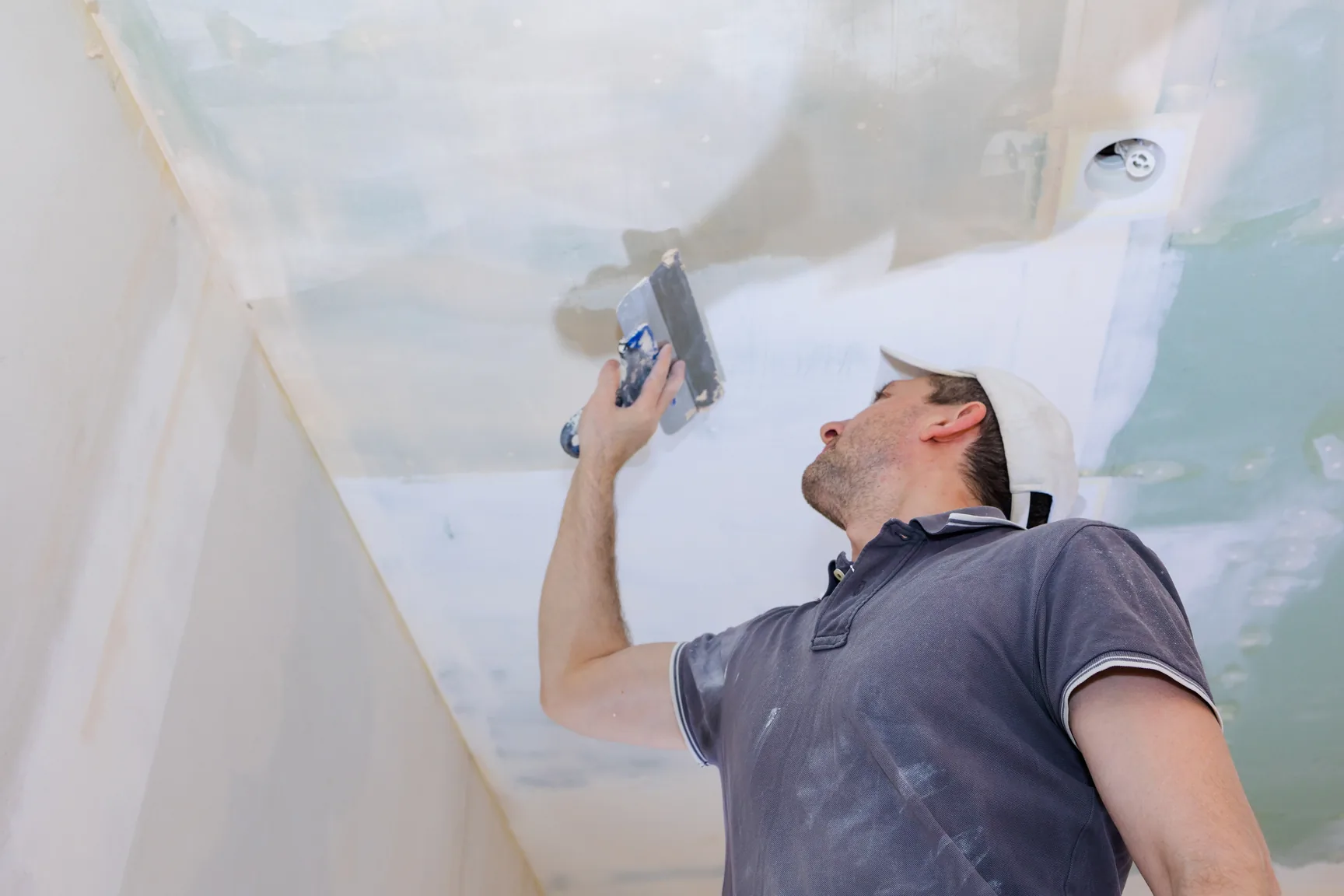
In Nebraska, the state keeps a register of contractors, and a drywall firm belongs on it before its crew starts any construction work. The Nebraska Department of Labor keeps that register, and the law behind it reaches drywall work through its definitions of construction and contractor rather than by naming the trade. Lead-safe renovation certification comes from EPA, while the state’s own lead law licenses abatement and keeps it apart from remodeling. The Nebraska Department of Health and Human Services administers the Asbestos Control Act and licenses the businesses and workers on asbestos projects. Workers’ compensation is compulsory, met through a licensed insurer or the court’s approval to self-insure, with no state fund.
Insurance itself gets little space here. The drywall contractor insurance page walks through the program as a whole, the residential drywall contractor insurance page deals with patch and refinish work in houses people are living in, and the commercial drywall contractor insurance page deals with board hung and finished under someone else’s subcontract. What follows is the Nebraska part.
A comparison in columns, read left to right. The left column is the registration on file with the state labor department. It comes before any construction work, and the Act reaches a drywall firm through its definitions of construction and contractor, which take in alterations, installations and repairs and include subcontractors and anyone supplying labor, without naming the trade. The application carries proof of workers’ compensation insurance, approved self-insurance or a signed statement that coverage is not required, and the legislature says the registration does not endorse the quality of any contractor’s work. The middle column is a license from the state health department. Under the Asbestos Control Act a business needs a license for an asbestos project, such as removing friable material or a demolition reaching material that may become friable when cut, unless the job stays under the Act’s small-project line or the department waives the license. The same department licenses lead abatement, which the state law says does not include renovation or remodeling. The right column is the federal certificate: lead-safe renovation certification comes from the federal agency, because Nebraska is not on its list of states running their own renovation programs. No figures are shown.
Construction, contractor, subcontractor: the definitions that pull a drywall firm in
Nebraska requires every contractor and subcontractor to register with the Nebraska Department of Labor before performing construction work in the state, under the Contractor Registration Act. The act does not name drywall or any other trade; it reaches drywall work through its own definitions, which make construction any work on real property, including new work, alterations, installations and repairs, and make a contractor anyone in the business of constructing, altering or repairing buildings. It is a registration, not a license by examination.
Authority: Neb. Rev. Stat. §48-2102; Neb. Rev. Stat. §48-2103(2), (3), (4); Neb. Rev. Stat. §48-2104(1); Neb. Rev. Stat. §48-2105(7)
The duty itself takes a single sentence of the Act:
“Before performing any construction work in Nebraska, a contractor shall be registered with the department.”
That sentence names no trade, so the reach comes from the definitions, and both are written wide:
“Construction means work on real property and annexations, including new work, additions, alterations, reconstruction, installations, and repairs performed at one or more different sites which may be dispersed geographically”
“Contractor means an individual, firm, partnership, limited liability company, corporation, or other association of persons engaged in the business of the construction, alteration, repairing, dismantling, or demolition of buildings …”
The contractor definition then reaches below the firm that signs with the owner:
“Contractor also includes any subcontractor engaged in the business of such activities and any person who is providing or arranging for labor for such activities, either as an employee or as an independent contractor, for any contractor or person”
A finishing outfit taping behind a builder’s hangers and a company that only supplies hangers both sit inside those words. As advice, never let a general contractor’s registration stand in for yours.
A drywall firm, including one that works only as a subcontractor or supplies labor to another contractor, registers with the department before it starts construction work in Nebraska and renews each year. The application carries proof of workers’ compensation insurance or approved self-insurance, or a signed statement that the firm is not required to carry it, and the department says a registration does not vouch for the quality of the work. The statute’s earnings floor appears below only as the statute prints it.
“Any person who performs work or has work performed on his or her own property or any person who earns less than five thousand dollars annually for construction services is not a contractor for purposes of the Contractor Registration Act.”
That exclusion is narrow: a person working on their own property, and a person whose construction earnings stay under the statute’s line. A business that means to grow should register early rather than hover under it.
Comp proof at sign-up, and a register that vouches for nobody’s work
The registration is tied to workers’ compensation from the application onward. The department’s page spells out the certificate a contractor with employees provides:
“All contractors with one or more employees must provide a current Workers’ Compensation Certificate of Insurance (ACORD 25) with the Department of Labor listed as the certificate holder.”
As advice, when a policy renews or moves to a new insurer, send a fresh certificate naming the department as holder and keep a copy with your registration papers.
What registration does not do is speak to workmanship. The legislature wrote that into the Act’s statement of purpose:
“It is not the intent of the Legislature to endorse the quality or performance of services provided by any individual contractor.”
A registration number shows a customer that your firm is on file, nothing more. A written scope, a certificate that answers the contract and finished walls that hold up are what set a firm apart.
Remodel or abate: the purpose test in the state’s lead law
EPA, not Nebraska, runs the lead-safe renovation (RRP) program here: Nebraska is not among the states EPA lists as authorized to run their own. The Nebraska Department of Health and Human Services tells homeowners that contractors who disturb painted surfaces in older homes, daycares and schools must be certified by EPA. The state’s own lead law licenses lead-based paint professionals and abatement firms, and it says abatement does not include renovation or remodeling.
Authority: 40 CFR Part 745, Subpart E; Neb. Rev. Stat. §71-6318.01(1); Neb. Rev. Stat. §71-6319.02; Neb. Rev. Stat. §71-6321(1), (6)
A crew opening a wall for new wiring or sanding a patch into an old finish is working on painted surfaces, and in older buildings the federal renovation rule governs that paid work. The federal agency’s list of states that run their own programs shows why it, and not the state, runs the program here:
“EPA administers the RRP Program in most Tribes, states and territories, but has authorized the following to operate their own programs: Alabama, Delaware, Georgia, Iowa, Kansas, Massachusetts, Mississippi, North Carolina, Oklahoma, Oregon, Rhode Island, Utah, Vermont, Wisconsin …”
Nebraska is absent from that list. The state’s own lead law, run by the Nebraska Department of Health and Human Services, Lead-Based Paint Program, licenses lead-based paint activities, and its definition of abatement closes with an exclusion that fits ordinary drywall work:
“Abatement does not include renovation, remodeling, landscaping, or other activities when such activities are not designed to permanently eliminate lead-based paint hazards but instead are designed to repair, restore, or remodel a structure or dwelling”
A drywall firm that cuts out, patches or sands painted walls and ceilings in older housing or a child-occupied facility follows EPA’s renovation rule, with EPA firm certification and a certified renovator, not a Nebraska license. A state license comes into play only when the job is abatement, work designed to permanently eliminate lead-based paint hazards, which the state law keeps separate from renovation.
The line turns on purpose, not on tools. As advice, read the owner’s request with care: repairing a damaged wall reads like renovation, but getting the lead out of a room for good may be abatement, so ask the department before you price that job.
Removal projects, demolition projects and the health department’s license
Nebraska administers its own asbestos program. The Asbestos Control Act, run by the Nebraska Department of Health and Human Services, licenses the businesses and workers on asbestos projects, and it reaches drywall tear-out through its categories rather than by naming drywall: removing friable asbestos-containing material, and demolishing structures with material that may become friable when cut or ground. The Department of Water, Energy, and Environment says it has been delegated the federal emission standard, and its guidance names joint compound and sprayed-on texturing among suspect materials.
Authority: Neb. Rev. Stat. §71-6301(5), (6), (7), (13); Neb. Rev. Stat. §71-6302; Neb. Rev. Stat. §71-6303(1); Neb. Rev. Stat. §71-6309(3); 178 NAC 22; Title 129, Nebraska Air Quality Regulations; 40 CFR 61, Subpart M
The Act names no wall material; its definitions decide which tear-outs it reaches. A removal project is defined by what comes off and what is meant to stay:
“Asbestos removal project means activities which include the physical removal of friable asbestos-containing material from the surface of a structure or from equipment which is intended to remain in place after the removal.”
Friable is a defined term, and the test is easy to picture:
“Friable asbestos means asbestos in a form which can be crumbled, pulverized, or reduced to powder by hand pressure”
Material that does not crumble today is not automatically outside the Act, because the demolition definition reaches material the work itself will break down:
“Asbestos-related demolition project means activities which include the razing of all or a portion of a structure which contains friable asbestos-containing materials or other asbestos-containing materials which may become friable when such materials are cut, crushed, ground, abraded, or pulverized”
Cutting, grinding and abrading are everyday verbs on a drywall job. As advice, when a bid calls for sawing out or sanding away an old finish, get a sample result first. Once a job is an asbestos project, the license duty falls on the business:
“a business entity shall not engage in an asbestos project unless the business entity holds a license for that purpose.”
Before cutting out or sanding an old wall or ceiling finish, a drywall firm has the material inspected or treats it as containing asbestos. If it does, a project above the act’s small-quantity line goes to a business licensed by the Department of Health and Human Services with licensed workers, unless the department waives the license for a firm not primarily in asbestos work that meets worker protection requirements; a smaller job still requires the firm to train its employees. Federal emission-standard notifications go to the Department of Water, Energy, and Environment.
A size line, a waiver and the training that survives both
A business outside the asbestos trade has ways to stand outside the license, and none of them means doing nothing. The first is size:
“A business entity which (1) only performs asbestos projects which are less than two hundred sixty linear feet or which are less than one hundred sixty square feet and linear feet in any combination … shall not be required to hold a license.”
Under that line, the Act still asks something of the employer:
“Business entities not required to hold a license shall provide a training course to inform the employees of the health and safety aspects of the asbestos project, including the applicable state standards.”
The department can also waive the license for a firm whose main work lies elsewhere:
“If the business entity is not primarily engaged in asbestos projects, the department may waive the requirement for a license upon application and payment of the fee prescribed by the department if worker protection requirements are met”
Neither route is automatic. As advice, decide before the busy season which path your firm is on, rather than measuring a ceiling halfway through a job to see whether you are under the line.
Homeowners, family and unpaid helpers: who the house exclusion is written for
The Act’s definition of an asbestos project ends with exclusions, and the exclusion that touches houses reads:
“but does not include … (b) any activities physically performed by a homeowner, a member of the homeowner's family, or an unpaid volunteer on or in the homeowner's residential property of four units or less”
The hired crew is not in it. The exclusion covers work physically performed by the homeowner, the homeowner’s family or an unpaid volunteer, on the homeowner’s own residential property within the size the definition prints, and a drywall firm paid to do the work is none of those. The Nebraska Department of Water, Energy, and Environment, in a guidance document that is not the Act, makes the same point from the contractor’s side:
“If a homeowner hires a contractor to remove ACM in their home, the contractor may be subject to the DHHS Nebraska Asbestos regulations (Title 178).”
The same guidance lists materials it treats as suspect, and among them are finishes a drywall crew handles every week. This is agency guidance, not the text of the Act:
“Suspected ACM include but are not limited to: floor tile, linoleum, pipe and boiler insulation, heat duct wrap and joint tape, … ceiling tiles, joint compound, sprayed-on-texturing, etc.”
As advice, if a homeowner has already scraped part of a ceiling and wants your crew to finish it, the exclusion covered the homeowner’s own hands, not yours. How liability policies treat asbestos and lead is covered on the general liability page.
An insurer licensed in the state, or the compensation court’s approval to self-insure
Workers’ compensation is compulsory in Nebraska for an employer with one or more employees in its regular business, and a drywall contractor is not among the listed exceptions. A covered employer insures with an insurer licensed to write workers’ compensation in the state or self-insures with the approval of the Nebraska Workers’ Compensation Court. Coverage comes from the private market, since Nebraska has no state fund.
Authority: Neb. Rev. Stat. §48-106(1), (2); Neb. Rev. Stat. §48-145(1), (3); Neb. Rev. Stat. §48-162.02(1); Neb. Rev. Stat. §48-1,103
The coverage section sets the law’s reach in a sentence that leaves little room for a working drywall shop:
“The Nebraska Workers' Compensation Act shall apply … to every resident employer in this state and nonresident employer performing work in this state who employs one or more employees in the regular trade, business, profession, or vocation of such employer.”
A covered employer meets the duty with a policy:
“Every employer in the occupations described in section 48-106 … shall either (a) insure and keep insured its liability under such act in some corporation, association, or organization authorized and licensed to transact the business of workers' compensation insurance in this state”
or through the compensation court rather than the insurance market:
“(d) with approval of the Nebraska Workers' Compensation Court, self-insure its workers' compensation liability.”
A drywall firm with employees carries a workers’ compensation policy, or holds the compensation court’s approval to self-insure, and shows that proof when it registers as a contractor. An employer that fails to insure or qualify answers to an injured employee in damages.
So the comp policy is shopped among insurers licensed to write it in Nebraska and kept in force without gaps, since the same proof sits in your registration file. The harder questions are about people: the hanger paid by the sheet, the finishing outfit that invoices as its own business. The workers’ compensation page works through how a policy and its audit treat them.
The labor department, the health department, the compensation court and the rest
Insurance companies and agencies in Nebraska answer to the Nebraska Department of Insurance. To confirm that an agency is licensed, ours among them, search it on NIPR.com.
Registration, asbestos, lead, emissions and comp each sit with a different body, linked here to its own site:
- Nebraska Department of Labor: statewide contractor registration under the Contractor Registration Act, which reaches drywall work
- Nebraska Department of Health and Human Services, Office of Environmental Health Hazards & Indoor Air (asbestos program): administers the Asbestos Control Act: licenses for asbestos business entities and asbestos occupations, work practices and project inspections
- Nebraska Department of Health and Human Services, Lead-Based Paint Program: licenses lead-based paint professionals and abatement firms under the Residential Lead-Based Paint Professions Practice Act; lead-safe renovation itself is EPA’s program here
- Nebraska Department of Water, Energy, and Environment: state environmental agency; delegated the federal asbestos emission standard and receives demolition and renovation notifications
- Nebraska Workers’ Compensation Court: administers the workers’ compensation act and decides disputes; approves employers to self-insure
Look for a drywall licensing board or a state comp fund on that list and you will not find either. As advice, call the building office where a job sits before you bid; this page covers the state’s rules, not a city’s.
A short list of metropolitan areas, taken from the Census Bureau’s delineation
The metro areas below are the metropolitan areas that take in a Nebraska county, those with a principal city in the state first, as the U.S. Census Bureau delineates them. The contractor registration is statewide, so it goes with a crew to any of the Nebraska counties listed.
Omaha, NE-IA
Part of this metro lies in another state; the counties listed here are its Nebraska side only: Cass County, Douglas County, Sarpy County, Saunders County and Washington County.
Lincoln, NE
The counties that make up this metro: Lancaster County and Seward County.
Grand Island, NE
The counties that make up this metro: Hall County, Howard County and Merrick County.
Sioux City, IA-NE-SD
Part of this metro lies in another state; the counties listed here are its Nebraska side only: Dakota County. Its principal city lies outside Nebraska.
As advice, note the county and city of each job on the work order; permits follow the building’s address, and a metro that crosses a state line puts some jobs under another state’s rules.
What the state checks, and what only your policies cover
The register, the license lines and the comp duty are what Nebraska looks at. None of them pays for a cracked ceiling, a stolen lift or a van in a ditch; those losses fall to policies that work the same way here as in any other state, each with a page of its own:
- General liability for a ceiling that fails after the owner moves back in.
- Workers’ compensation for the crew and the certificate your registration depends on.
- Commercial auto for the vans hauling board and lifts.
- Inland marine coverage for tools and equipment for banjos, flat boxes and sanders.
- Umbrella liability when a subcontract asks for higher limits.
- Commercial property for the shop and its racks.
A firm that mostly patches walls for homeowners leans on its liability policy; a firm that hangs whole floors for builders lives by the subcontract’s certificate list. Tell us how your year splits, and the quote follows it.
State rules decide who may do the work and how; the policies decide who pays when something goes wrong.
- A license, registration or certification is a requirement of the state, not insurance.
A panel for Nebraska in rows. Each row sets a requirement of the state beside the exposure that requirement leaves open and the coverage line that answers it. Contractor license: A state license or registration reaches drywall work. It leaves open injury and damage to others from the work, during the job and after it, which General Liability answers. Lead-safe renovation: The federal program runs lead-safe renovation here. It leaves open paint dust disturbed when older walls are cut, patched or sanded, which General Liability answers. Asbestos in wall and ceiling material: A state program reaches removal of this material. It leaves open disturbing older joint compound, wallboard or plaster, which General Liability answers. Workers’ compensation: Required for covered employers, bought in the open market. It leaves open a crew member hurt on the job, which Workers’ Compensation answers. Notes: A license, registration or certification is a requirement of the state, not insurance. The conclusion reads: State rules decide who may do the work and how; the policies decide who pays when something goes wrong. No figures are shown.
Nebraska coverage, services and state offices
What we insure
Coverage lines
Outside authorities
- Nebraska Department of Insurance
- Nebraska Department of Labor
- Nebraska Department of Water, Energy, and Environment
- Nebraska Department of Health and Human Services, Office of Environmental Health Hazards & Indoor Air (asbestos program)
- Nebraska Workers’ Compensation Court
- Nebraska Department of Health and Human Services, Lead-Based Paint Program
Nebraska drywall contractor insurance questions
We supply hangers to other contractors’ jobs and never run a project ourselves. Is a labor supplier on the registration list?
Yes. The Act’s definition of a contractor includes any subcontractor and any person providing or arranging labor for construction work, whether as an employee or as an independent contractor, so a labor-only drywall business registers with the Nebraska Department of Labor before its people start work in Nebraska.
Can we tell homeowners that our state registration shows our work is good?
No. The legislature wrote that it does not intend to endorse the quality or performance of any contractor’s services, and the Nebraska Department of Labor says the registration does not ensure quality of work or protect against fraud. As advice, point customers to your written scope, your references and your insurance certificate instead.
We only take a few patch jobs on the side. Is there an earnings line below which we are not a contractor under the Act?
There is. The Act says a person who earns less than the annual amount it prints for construction services is not a contractor for its purposes, and the same goes for work on your own property. As advice, if the side work is meant to grow into a business, register before you cross the line rather than after.
A landlord wants every painted wall in an old duplex taken out so the lead is gone for good. Is that still renovation?
It may not be. The state’s lead law says abatement does not include renovation or remodeling designed to repair, restore or remodel, which leaves work designed to permanently eliminate lead-based paint hazards on the abatement side, where the Nebraska Department of Health and Human Services, Lead-Based Paint Program licenses the individuals and firms. Ordinary cut-and-patch renovation answers to EPA’s certification. When the owner’s goal is permanent removal, ask the department before you price it.
Our asbestos job falls under the Act’s size line. Does that mean nothing is required of us?
No. A business that only performs projects under the line the Act prints does not need the license, but it must still provide its employees a training course on the health and safety aspects of the project, including the applicable state standards. As advice, hold that training before the job, not after, and keep a record of who attended.
Asbestos work is not our main business. Can the state let us handle a project without the full license?
The Act lets the Nebraska Department of Health and Human Services waive the license for a business not primarily engaged in asbestos projects, on application and payment of its fee, if worker protection requirements are met. The waiver is the department’s to grant, so apply and have the answer in hand before the crew is scheduled.
Whose name goes on the comp certificate we send in with our registration?
The department’s. The Nebraska Department of Labor’s registration page says contractors with employees must provide a current workers’ compensation certificate of insurance with the department listed as the certificate holder. Ask your agent for that certificate when the policy is written and again at each renewal.
This page describes insurance for drywall contractors operating in this state. It is general information, not legal advice and not a statement of coverage. Licensing, lead-safe and asbestos requirements change; verify current requirements with the agency named before relying on them.
Get a quote for your Nebraska drywall work
Tell us whether your crews work under other contractors or sign with owners, what kinds of older walls they open and who is on the payroll, and we will put the Nebraska program together from there.