
Drywall Contractor Insurance by State
Virginia Drywall Contractor Insurance
In Virginia the contractor board licenses drywall as a specialty of its own, lead-safe renovation certification stays federal, asbestos licensing carries no residential exception, and workers’ compensation is compulsory with no state fund.
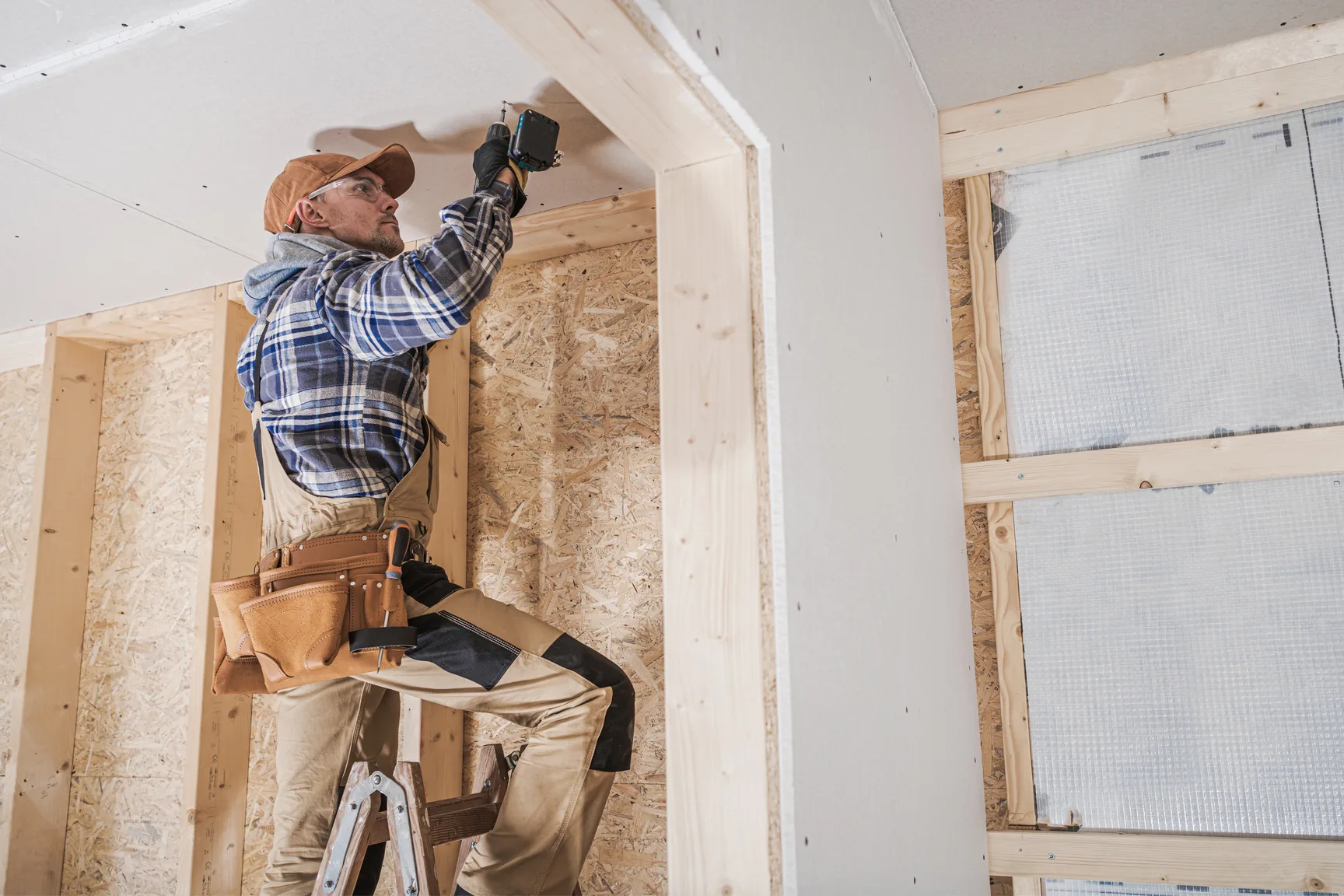
Virginia’s contractor regulations give drywall an entry of its own. The Board for Contractors defines a drywall contracting specialty, and the Code of Virginia bars anyone from contracting work in the Commonwealth without a license once a job is above the smallest value the statute sets. Lead-safe renovation certification for older painted walls comes from EPA, not from the state. The asbestos law reaches any asbestos-containing material a project removes, repairs or alters, and its licensing sections carry no residential exception. Workers’ compensation is compulsory for the employers the law covers, bought in the private market because there is no state fund.
Each finding has an edge that is easy to miss: a license class that has to grow with your jobs, a state lead license that does not certify renovators, and a home carve-out that reaches a permit fee but not licensing. The sections below take them in turn, with the source’s own words where they carry the point.
How the policies work for a drywall business is set out on the drywall contractor insurance page. This page keeps to what is particular to Virginia, whether your crews repair walls in lived-in homes, the subject of the residential drywall contractor insurance page, or hang board on general contractors’ projects, which the commercial drywall contractor insurance page covers.
A stack of credentials, read from top to bottom, from the license nearly every sizable job needs to the ones only particular work calls for. At the top is the contractor license from the state board, needed to contract or offer drywall work above the smallest jobs, in a class that follows the value of the work. Below it is the drywall contracting specialty, which covers hanging, taping and finishing gypsum wallboard and framing ceilings and nonstructural partitions with sheet metal studs; the building classifications and the improvement specialties reach the same work. Below that sits the local business license or permit a city or county may still ask for. Next is the federal lead-safe renovation certificate, which the federal environmental agency issues for paid work that disturbs paint in older homes and child-occupied facilities. Below it is the state lead abatement license, which reaches work meant to eliminate lead hazards and leaves ordinary repair and remodeling outside. At the bottom are the asbestos licenses: a contractor license to contract for any project that removes, repairs or alters asbestos-containing material, and supervisor and worker licenses for each person on that project. No figures are shown.
A drywall specialty written into the contractor regulations
Virginia licenses drywall work through its statewide contractor law, and the Board for Contractors names the trade outright. The Code of Virginia bars anyone from contracting work in the Commonwealth without a license, sorts licenses into classes by the value of the work, and the board’s regulations define a drywall contracting specialty that covers hanging, taping and finishing gypsum wallboard and installing sheet metal studs.
A drywall firm that bids or takes on work above the smallest value the statute sets needs a license from the Board for Contractors, in a class that matches the size of its jobs and with a specialty or classification that covers drywall. The license comes from the Department of Professional and Occupational Regulation, not from the city, though a locality may still ask for its own business license or permits.
Authority: Va. Code § 54.1-1100; Va. Code § 54.1-1103(A); 18VAC50-22-30
The board’s definition reads like an ordinary week on a drywall crew:
“means the service that provides for the installation, taping, and finishing of drywall, panels and assemblies of gypsum wallboard, sheathing, and cementitious board, and the installation of studs made of sheet metal for the framing of ceilings and nonstructural partitioning.”
Taping and finishing sit beside installation, so the finishing side of the trade is inside the specialty, and metal stud framing for ceilings and nonstructural partitions is too, which matters to a crew that frames its own walls. The definition then names the broader licenses that reach the same work:
“The CBC and RBC classifications and HIC and CIC specialties also provide for this function.”
Those are the board’s commercial and residential building classifications and its home and commercial improvement specialties. A business holding one of them may already be covered for drywall; a business that does only drywall can hold the narrower specialty. The board’s page, which is guidance rather than the statute, explains how the parts fit:
“Contractor licenses consist of two parts: the class of license (A, B, or C), which determines the monetary value of contracts/projects that may be performed, and the classification/specialty, which determines what type of work is allowed.”
Bidding, offering and the jobs too small for the license
The requirement reaches the offer as well as the work:
“No person shall engage in, or offer to engage in, contracting work in the Commonwealth unless he has been licensed under the provisions of this chapter.”
The statute’s definition of a contractor turns on being paid to bid on, accept or perform the work:
“any person, that for a fixed price, commission, fee, or percentage undertakes to bid upon, or accepts, or offers to accept, orders or contracts for performing … the construction, removal, repair, or improvement of any building or structure”
The lowest class sets the floor, and its definition gives the range it covers:
“perform or manage construction, removal, repair, or improvements when (i) the total value referred to in a single contract or project is over $1,000 but less than $30,000”
Work at or below the bottom of that range falls outside the license. Above it, the class you need rises with the value of your contracts and projects, so a business that began with patch work and now prices whole office floors may have outgrown its class.
The sources behind this page do not settle whether a drywall firm under a licensed general contractor can rely on that contractor’s license. As advice:
- Compare each large job’s contract value with the class you hold, counting the change orders likely to follow.
- If you work under general contractors, ask the Board for Contractors in writing whether your arrangement needs a license of your own, and keep the answer on file.
- Remember that a city or county may still want its own business license or permit for the job.
The certificates and additional insured wording a general contractor asks for are taken up on the commercial drywall contractor insurance page.
Repair work, abatement work and who certifies each
Virginia is not an authorized RRP state: EPA administers the lead renovation, repair and painting (RRP) program there, so the lead-safe certification a drywall firm needs for paid work that disturbs paint in older homes and child-occupied facilities comes from EPA.
Authority: 40 CFR Part 745; Va. Code § 54.1-500; 18VAC15-30-20
Cutting out a stained section or feathering a patch into an old finish disturbs paint, and the federal rule is written for that kind of paid work:
“In general, anyone paid to perform work that disturbs paint in housing and child-occupied facilities built before 1978 must be certified in lead-safe work practices.”
Virginia does license lead work of its own, which is where crews get confused.
Virginia’s own lead licensing, run by the Board for Asbestos, Lead, and Home Inspectors, reaches lead-based paint activities — inspection, risk assessment, project design and abatement — and the board’s regulation says abatement does not include renovation or remodeling meant to repair or restore a building. Ordinary wall and ceiling repair in older housing therefore answers to the federal renovation rule, while deliberate lead abatement needs a Virginia license.
The statute’s list of licensed activities leaves renovation out:
“means lead inspection, lead risk assessment, lead project design and abatement of lead-based paint and lead-based paint hazards, including lead-contaminated dust and lead-contaminated soil.”
And the board’s regulation draws the line against the work a drywall crew does:
“Abatement does not include renovation, remodeling, landscaping, or other activities when such activities are not designed to permanently eliminate lead-based paint hazards, but instead are designed to repair, restore, or remodel a given structure or dwelling”
So the split is this: repairing or remodeling walls in an older home or child-occupied facility calls for the certificate from EPA, while work meant to permanently eliminate lead hazards is abatement and belongs to a state licensee. As advice, put the building’s age on the estimate sheet, ask whether children use the building regularly, and refer any job whose point is removing lead paint to a licensed abatement firm.
Older homes raise these questions often, which is why the residential drywall contractor insurance page spends time on them; how a liability policy treats a contaminant claim is on the general liability page.
How the asbestos law reaches a wall it never names
Virginia’s asbestos law reaches drywall tear-out through its definitions rather than by naming drywall: an asbestos project is any activity involving removal, renovation, repair or alteration of an asbestos-containing material, and only a licensed asbestos contractor may contract to carry one out, with licensed supervisors and workers doing the work. The law carves out nonfriable roofing, flooring and siding, not wall or ceiling finishes. Its residential relief is narrower than an exemption from licensing: the project permit and the building-permit inspection rule leave out homes and small residential buildings.
Authority: Va. Code § 54.1-500; § 54.1-503(A); § 54.1-504; § 40.1-51.20(B); § 36-99.7(C); 18VAC15-21-10; 16VAC25-20-10
The asbestos texts behind this page never mention joint compound, wallboard or plaster. They do not need to, because the definition of a project is wide:
“means an activity involving job set-up for containment, removal, encapsulation, enclosure, encasement, renovation, repair, construction or alteration of an asbestos-containing material.”
Repair and alteration are the everyday work of a crew opening an older wall. The material is defined by content, not by trade name:
“means any material or product which contains more than 1.0 percent asbestos or such other percentage as established by EPA final rule.”
The only materials the statute leaves out are these, and wall and ceiling finishes are not among them:
“An asbestos project or asbestos abatement project shall not include nonfriable asbestos-containing roofing, flooring and siding materials which when installed, encapsulated or removed do not become friable.”
Friability is the test, and a crew’s tools can change it:
“means that the material when dry may be crumbled, pulverized, or reduced to powder by hand pressure”
Once a job is an asbestos project, the contractor needs a license to take it on, and each person on it needs a license too:
“It shall be unlawful for any person who does not have an asbestos contractor's license to contract with another person, for compensation, to carry out an asbestos project or to perform any work on an asbestos project.”
“it shall be unlawful for an individual who does not have an asbestos supervisor's license or worker's license to work on an asbestos project.”
The Virginia Department of Labor and Industry, which handles asbestos notification and permits, adds guidance on surveys and on what tools do. This is the department’s guidance, not the law:
“An asbestos survey is required before any renovation or demolition activity begins. Asbestos surveys must be performed by state-licensed asbestos inspectors.”
“Activities such as grinding, mechanical chipping, sawing or drilling can make the asbestos containing material friable and would require notification.”
That second sentence describes a drywall crew’s ordinary cutting and drilling. As advice, settle what is in an old finish before anyone saws or grinds it, and let the survey and the law, not how solid the wall feels, decide.
Houses, small apartment buildings and the relief the law gives them
Owners who work in homes often hear that houses are exempt. The law’s words are narrower. The project permit and fee requirement says this:
“The provisions of this subsection shall not apply to asbestos projects in residential buildings as defined by the Board in regulations adopted pursuant to the Administrative Process Act”
A separate statute requires an asbestos inspection before a building permit for renovation or demolition, and it sets homes aside with a condition attached:
“The provisions of this section shall not apply to single-family dwellings or residential housing with four or fewer units, unless the renovation or demolition of such buildings is for commercial or public development purposes.”
That is relief from a permit, a fee and a permit-linked inspection. Neither sentence touches the licensing sections quoted above, which state no residential exception, so asbestos removal in a house is still licensed work. The inspection carve-out also ends where the work is for commercial or public development.
- On a commercial job, ask for the asbestos survey before you price the demolition.
- On a house, do not read the carve-outs as permission; have suspect material tested before the crew disturbs it.
- If asbestos material must come out and you do not hold the license, schedule a licensed asbestos contractor first.
Whether a liability policy responds to an asbestos claim is taken up on the general liability page.
Small crews, the employee definition and private-market coverage
Workers’ compensation is compulsory in Virginia for the employers its law covers. A covered employer must insure with an insurer authorized to write the coverage in the Commonwealth, be certified as a self-insurer, or join a licensed group self-insurance association, and the Virginia Workers’ Compensation Commission says Virginia has no state fund, so coverage comes from the private market.
Authority: Va. Code § 65.2-800(A); § 65.2-801(A); § 65.2-101 («Employee», subdivision 2 h)
“Every employer subject to the compensation provisions of this title shall insure the payment of compensation to his employees in the manner hereinafter provided.”
Which employers that reaches depends on the Act’s definition of an employee, which leaves out the workers of a business below a certain size:
“Employees of any person, firm or private corporation, including any public service corporation, that has regularly in service less than three employees in the same business within this Commonwealth, unless such employees and their employers voluntarily elect to be bound by this title.”
The Virginia Workers’ Compensation Commission states the same line from the other side, counting part-time workers too:
“Virginia law requires that an employer who regularly employs more than two part-time or full-time employees carry Virginia workers' compensation coverage.”
The word to watch in both is regularly. As advice, count everyone you regularly have in service, part-time hangers and finishers included, before deciding the Act does not reach you. The first route the Act gives a covered employer is an authorized insurer:
“Insuring and keeping insured his liability in an insurer authorized to transact the business of workers' compensation insurance in this Commonwealth”
“Virginia does not have a State Fund. Coverage is available through an insurance agent or carriers.”
Crews paid by the board or the foot, finishing outfits brought in under a separate business and the certificates they should hand you are policy questions, set out on the workers’ compensation page.
Agencies to call before the bid, and what each one decides
The State Corporation Commission Bureau of Insurance regulates insurance in the state. You can look up an insurance agency’s license, ours included, on NIPR.com. The other offices this page draws on, with each role as the record verified it:
- Virginia Department of Professional and Occupational Regulation: statewide professional and occupational licensing, home of the contractor and asbestos-lead boards
- Board for Contractors: contractor licensing by class and by classification or specialty, including the drywall contracting specialty
- Board for Asbestos, Lead, and Home Inspectors: licensing of asbestos contractors, supervisors, workers and inspectors, and of lead-based paint activity
- Virginia Department of Labor and Industry: asbestos and lead project notification and permits, asbestos NESHAP enforcement and the VOSH asbestos and lead construction standards
- Virginia Workers’ Compensation Commission: workers’ compensation administration and self-insurance certification
The same board licenses asbestos and lead abatement work, so it appears once. The renovation certificate comes from EPA, and the local offices where your jobs sit are on no statewide list.
Metro areas by county and city
The metro areas below are the largest metropolitan areas whose principal cities are in Virginia, as the U.S. Census Bureau delineates them. The contractor license comes from the state board wherever the job sits, while a locality may still ask for its own business license or permits.
Washington-Arlington-Alexandria, DC-VA-MD-WV
This metro crosses the state line, and this card names only its Virginia counties and cities: Arlington County, Clarke County, Culpeper County, Fairfax County, Fauquier County, Loudoun County, Prince William County, Rappahannock County, Spotsylvania County, Stafford County, Warren County, Alexandria city, Fairfax city, Falls Church city, Fredericksburg city, Manassas city and Manassas Park city.
Virginia Beach-Chesapeake-Norfolk, VA-NC
This metro crosses the state line, and this card names only its Virginia counties and cities: Gloucester County, Isle of Wight County, James City County, Mathews County, Surry County, York County, Chesapeake city, Hampton city, Newport News city, Norfolk city, Poquoson city, Portsmouth city, Suffolk city, Virginia Beach city and Williamsburg city.
Richmond, VA
Virginia counties and cities in this metro: Amelia County, Charles City County, Chesterfield County, Dinwiddie County, Goochland County, Hanover County, Henrico County, King and Queen County, King William County, New Kent County, Powhatan County, Prince George County, Sussex County, Colonial Heights city, Hopewell city, Petersburg city and Richmond city.
Roanoke, VA
Virginia counties and cities in this metro: Botetourt County, Craig County, Franklin County, Roanoke County, Roanoke city and Salem city.
Lynchburg, VA
Virginia counties and cities in this metro: Amherst County, Appomattox County, Bedford County, Campbell County and Lynchburg city.
Charlottesville, VA
Virginia counties and cities in this metro: Albemarle County, Fluvanna County, Greene County, Nelson County and Charlottesville city.
As advice, track the county or city of every job, not just the metro, because the local license and permit office change from locality to locality.
Licensed, insured and ready to bid: the coverage side
The coverage that answers for the work itself is the set of policies a drywall business carries wherever it works:
- General liability for injury and damage to others, finished work and tear-out included.
- Workers’ compensation for the crew, including crews paid by the piece.
- Commercial auto for the vans that move board, mud and lifts.
- Inland marine coverage for tools and equipment for lifts, taping tools and sanders.
- Umbrella liability for limits above the primary policies, often required in a subcontract.
- Commercial property for the shop and what is kept in it.
As your license class grows with your jobs, expect the insurance terms in your contracts to grow with it. When you are ready to put the pieces together for Virginia work, a quote request is the place to start.
State rules decide who may do the work and how; the policies decide who pays when something goes wrong.
- A license, registration or certification is a requirement of the state, not insurance.
A panel for Virginia in rows. Each row sets a requirement of the state beside the exposure that requirement leaves open and the coverage line that answers it. Contractor license: A state license or registration reaches drywall work. It leaves open injury and damage to others from the work, during the job and after it, which General Liability answers. Lead-safe renovation: The federal program runs lead-safe renovation here. It leaves open paint dust disturbed when older walls are cut, patched or sanded, which General Liability answers. Asbestos in wall and ceiling material: A state program reaches removal of this material. It leaves open disturbing older joint compound, wallboard or plaster, which General Liability answers. Workers’ compensation: Required for covered employers, bought in the open market. It leaves open a crew member hurt on the job, which Workers’ Compensation answers. Notes: A license, registration or certification is a requirement of the state, not insurance. The conclusion reads: State rules decide who may do the work and how; the policies decide who pays when something goes wrong. No figures are shown.
Nearby states we also write
Virginia coverage, services and state offices
What we insure
Coverage lines
Outside authorities
- State Corporation Commission Bureau of Insurance
- Virginia Department of Professional and Occupational Regulation
- Board for Contractors
- Board for Asbestos, Lead, and Home Inspectors
- Virginia Department of Labor and Industry
- Virginia Workers’ Compensation Commission
- Board for Asbestos, Lead, and Home Inspectors
Virginia drywall contractor insurance questions
Our crew only tapes and finishes; another outfit hangs the board. Does the drywall specialty still describe our work?
The Board for Contractors’s regulation defines drywall contracting as installation, taping and finishing together, so the finishing side of the trade sits inside the same specialty. How the board treats a firm that does only part of that work is a question for the board itself; describe your scope in writing when you apply and keep its answer on file.
We already hold a residential building classification. Do we have to add the drywall specialty on top of it?
The same regulation says the commercial and residential building classifications and the home and commercial improvement specialties also provide for drywall work. If your license carries one of those, the drywall function is already within it in the regulation’s words. Confirm the fit with the Board for Contractors before you rely on it for a bid.
Is there a job size below which we can hang and finish without a Virginia contractor license?
The statute’s lowest license class begins above a set contract value, which the class definition quoted on this page prints, and work at or below that value falls outside it. Measure each contract or project against that line, change orders included, and keep in mind that a city or county may still ask for its own business license or permit.
A property manager asked whether our lead paperwork is a Virginia license or a federal one. Which is it?
Federal. EPA administers the renovation program in Virginia, and the renovation certificate comes from it. The state’s own lead licensing, run by the Board for Asbestos, Lead, and Home Inspectors, reaches inspection, risk assessment, project design and abatement, and its regulation says abatement does not include repair or remodeling work.
Someone told us houses are left out of Virginia’s asbestos law. Is that right for a crew taking down an old ceiling?
Not as a general rule. The licensing sections, which require an asbestos contractor license to contract for an asbestos project and a supervisor or worker license to work on one, state no residential exception. The carve-outs for homes and small residential buildings sit in the project permit and fee rule and in the rule on asbestos inspection before a building permit. Ask the Board for Asbestos, Lead, and Home Inspectors before your crew disturbs a ceiling that may contain asbestos.
We saw and drill through old wall finishes on most jobs. Can that change how the asbestos rules treat the material?
It can. The statute’s test is whether the material, when dry, can be crumbled or reduced to powder by hand pressure, and the Virginia Department of Labor and Industry’s guidance says grinding, mechanical chipping, sawing or drilling can make asbestos-containing material friable and would require notification. Settle what is in the wall before the saw comes out.
We are about to hire another taper. At what crew size does Virginia expect a workers’ compensation policy?
The line sits in the Act’s definition of an employee, quoted on this page, and the Virginia Workers’ Compensation Commission states it in its own words, counting part-time as well as full-time employees. Once your crew is regularly over that line, the Act requires you to insure, and the coverage comes from the private market because Virginia has no state fund.
This page describes insurance for drywall contractors operating in this state. It is general information, not legal advice and not a statement of coverage. Licensing, lead-safe and asbestos requirements change; verify current requirements with the agency named before relying on them.
Get a quote for your Virginia drywall work
Start with the license class and specialty you hold, the age of the buildings your crews open up and how the crew is paid, and we will line the coverage up against that work.